
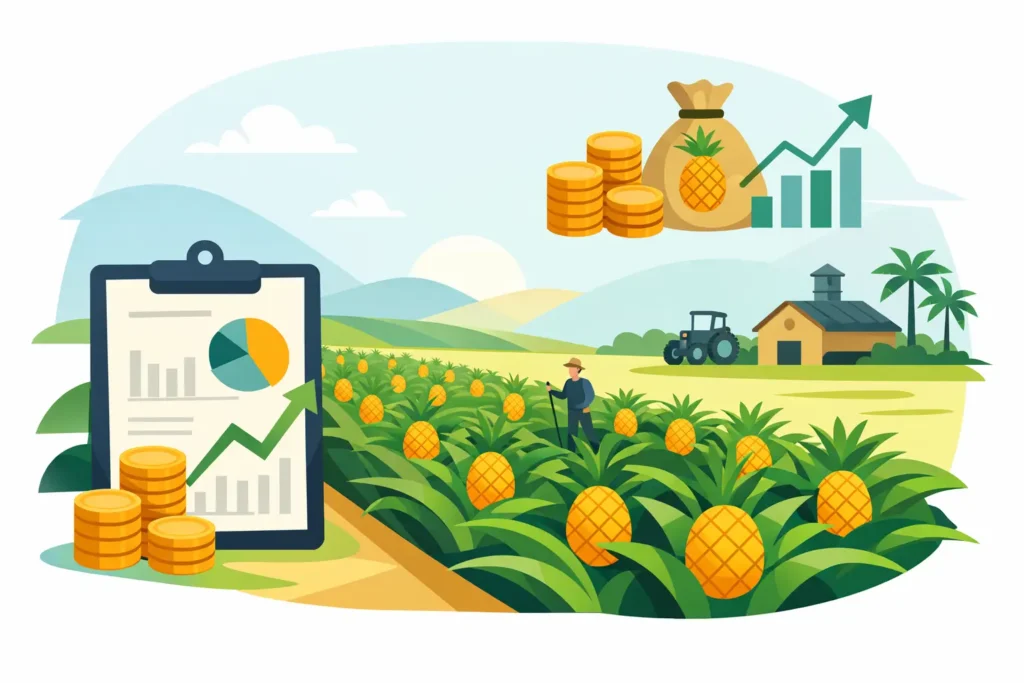
A pineapple farm does not become an attractive investment because it looks productive from the road. It becomes attractive when net revenue from pineapple acreage holds up after labor, inputs, supervision, crop handling, and export-focused operating costs are accounted for. For serious buyers, that is the line that matters most, because gross crop value can look impressive while actual earnings tell a very different story.
This is where acreage quality and operating structure start to separate ordinary farmland from a business asset. Pineapple production is not just about planting more hectares. It is about turning each producing hectare into repeatable net income, then scaling that model without losing control of costs or crop quality.
What net revenue from pineapple acreage really measures
Net revenue from pineapple acreage is the income generated from producing land after direct and operational costs are deducted. In practical terms, it is the number an investor uses to judge whether a pineapple farm is simply active or genuinely profitable.
That distinction matters. A farm may report strong sales from harvested fruit, but if fertilizer costs are high, labor is poorly managed, drainage is weak, or technical oversight is inconsistent, the bottom line can shrink quickly. Net revenue cuts through that noise. It shows what the acreage is actually earning once the farm has done the work required to produce marketable fruit.
For a buyer evaluating a tropical farm business, this metric also helps answer a more important question: can the current system produce dependable returns without requiring the owner to build management from scratch?
Why pineapple acreage is a strong profit lens
Pineapple is an operational crop. It rewards land quality, discipline, and efficient field management. That makes it well suited to acreage-based analysis because production can be measured clearly against planted area, crop cycle timing, and marketable output.
On a farm with active pineapple production, each planted hectare carries a direct relationship to revenue potential. But not every hectare performs the same. Soil condition, planting density, road access, labor coordination, and technical crop management all influence whether that hectare becomes a high-performing unit or an expensive underperformer.
For investors, acreage gives structure to the investment case. It creates a measurable base for analyzing productivity today and expansion tomorrow. A 67-hectare farm with nearly 20 hectares already in active pineapple production and capacity to scale to 35 hectares presents a very different opportunity from raw land with no operational proof.
The main drivers behind net revenue from pineapple acreage
The first driver is yield quality, not just yield volume. Export-grade pineapple production depends on consistent fruit size, appearance, and handling. Higher-quality output supports stronger pricing, while rejected or downgraded fruit reduces realized revenue even when tonnage appears healthy.
The second driver is cost control at field level. Pineapple farming can be profitable, but it is not passive by default. Labor organization, contractor efficiency, fertilization schedules, weed control, crop protection, and harvest timing all affect margin. Farms with local supervision and agricultural accounting oversight tend to protect net revenue better because they monitor spending in real time rather than after the season is over.
The third driver is infrastructure that supports movement and execution. Direct road access to a main road is not a small operational detail. It affects transport efficiency, labor access, input delivery, and post-harvest movement. In commercial farming, those details show up in margin.
The fourth driver is expansion readiness. If a farm already has a working operating model and room to increase planted area, future net revenue can improve without the same startup friction a buyer would face on undeveloped land. That is where scalable acreage becomes commercially meaningful.
Net revenue from pineapple acreage and the value of an existing system
Many buyers underestimate how much value sits inside a functioning management structure. Productive acreage is one asset. Productive acreage with established supervision, technical expertise, and financial oversight is a different class of asset.
That is especially true for absentee or internationally based owners. If the farm depends on the owner being in the field every day, the investment becomes operationally fragile. If the farm already uses local supervision, contractor-based labor, and agricultural accounting controls, the acreage is supported by a system designed to preserve margin.
This is one reason turnkey farm businesses can command stronger buyer interest than bare farmland. The buyer is not only acquiring land. The buyer is acquiring a method of converting that land into income.
How buyers should assess profit per producing hectare
A smart buyer does not stop at total farm revenue. The better question is what each producing hectare is contributing after real costs. That figure gives a cleaner view of current performance and makes future scaling easier to model.
If nearly 20 hectares are already in production, those hectares offer operating evidence. They show whether the farm can plant, maintain, harvest, and move product within a controlled cost structure. If the same farm has capacity to expand to 35 hectares, the next question is whether that added acreage can be brought online using the same management discipline.
This is where commercial buyers should stay balanced. More planted area can increase total earnings, but expansion also raises working capital needs, labor coordination demands, and exposure to execution risk. The upside is real, but so is the need for capable oversight. Strong net revenue per hectare matters more than simply chasing maximum planted area.
What makes scalable pineapple land more valuable
Scalable land is valuable when expansion is realistic, not theoretical. Some farms advertise acreage that could be planted someday, but the buyer still has to solve access, staffing, technical planning, and field organization. That is not the same as owning a farm with active production, proven road access, and a management structure already built around commercial output.
In that setting, future pineapple acreage is not just empty space. It is growth inventory. It represents the ability to increase productive area within an operating platform that already understands the crop, the labor model, and the standards required for export-oriented production.
That changes the investment profile. Instead of buying a concept, the buyer is stepping into a producing business with visible room to increase revenue-generating hectares.
Why export-grade production changes the revenue picture
Pineapple acreage tied to export-grade output generally carries a stronger commercial case than acreage aimed at inconsistent local channels. Export-focused farming demands more discipline, but it also creates clearer standards for crop quality and market positioning.
That said, export orientation is not automatic profit. It requires technical crop management, quality control, timing, and dependable handling. The advantage is that when those pieces are already in place, they support more predictable revenue performance. Buyers are not left guessing whether the land can produce. They are evaluating a farm that has already aligned itself with commercial-grade output.
For investors, this matters because net revenue is not only about what the crop can sell for. It is about whether the operation can consistently deliver fruit that earns the stronger value available in organized markets.
The investor case for net revenue from pineapple acreage
For land buyers looking beyond residential or speculative holdings, pineapple acreage offers something much more concrete: productive land with measurable commercial output. Net revenue is the bridge between agricultural appeal and investor logic.
A farm with fertile land, active production, direct road access, and room to expand offers more than ownership. It offers a platform for cash-generating agriculture in a sector tied to essential demand. That combination tends to stand out with buyers who want a hard asset, income potential, and a business model that does not depend on building every system from zero.
Buymyfarm.Co positions this kind of property exactly where serious buyers want it – not as a lifestyle fantasy alone, but as an operating farm business with acreage, output, and scalability that can be evaluated in financial terms.
For the right buyer, the appeal is straightforward. You are not just asking whether the land can grow pineapples. You are asking whether the acreage is already proving its ability to produce net income, and whether that income can grow under disciplined management. That is the kind of farmland opportunity worth paying attention to.
The best farm investments usually look simple after the hard work has already been organized. When net revenue per hectare is clear, operations are in place, and expansion is realistic, the decision becomes less about speculation and more about buying a business that happens to come with land.