
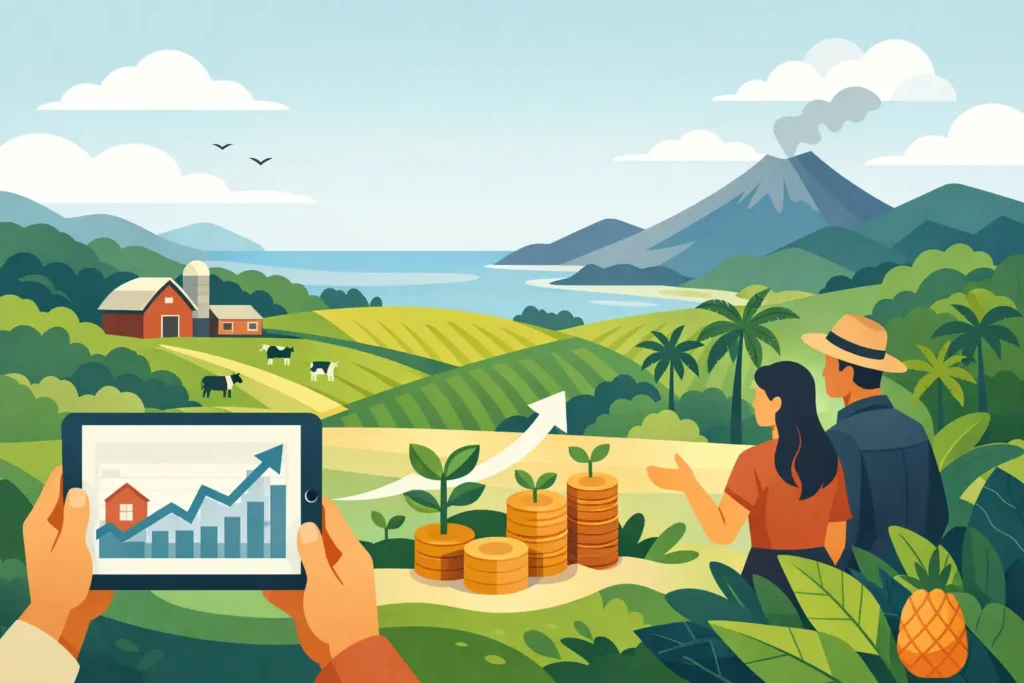
A serious farm invest Costa Rica opportunity should do more than sell scenery and acreage. It should show productive land, current output, operating discipline, and a realistic path to higher returns. That is the difference between buying rural property and acquiring an agricultural business.
For many US buyers, Costa Rica stands out because it offers fertile growing conditions, international appeal, and a stable foundation for land ownership. But not every farm purchase deserves investor attention. If the asset is not already producing, if labor is unstructured, or if expansion depends on guesswork, the risk rises fast. Buyers looking for dependable agricultural income usually want a farm that already knows how to work.
What makes a farm invest Costa Rica deal attractive
The strongest opportunities combine three things: land value, crop income, and operational readiness. Remove any one of those and the investment becomes weaker. Good land without production is speculative. Production without systems is fragile. Systems without room to grow can limit upside.
That is why productive pineapple farmland gets attention. Pineapple is not a hobby crop. It is a commercial crop with export relevance, defined quality standards, and measurable per-hectare economics. For an investor, that matters because performance can be tracked through acreage, yields, cost controls, harvest timing, and marketable fruit quality.
Costa Rica also has an advantage that many buyers understand immediately. This is a country known for agriculture, global produce exports, and year-round growing conditions. For an investor seeking hard assets tied to food demand, that creates a stronger logic than buying undeveloped land and hoping future value appears on its own.
Productive acreage changes the risk profile
A farm with active production is fundamentally different from vacant agricultural land. If a property already has nearly 20 hectares in pineapple production on a 67-hectare farm, the buyer is not starting from zero. There is already a commercial base, not just a plan on paper.
That matters because startup farming is expensive in all the wrong ways. New buyers often underestimate land preparation, crop scheduling, contractor management, technical supervision, accounting control, and harvest coordination. They may buy a beautiful property and then spend months or years building the machine required to generate revenue.
An operating farm reduces that friction. Existing production provides a live test of the land, the crop, and the management model. It also gives buyers something more valuable than optimism – actual activity. When a property has direct road access to the main road, current pineapple output, and the capacity to scale planting up to 35 hectares, the case becomes commercial rather than theoretical.
Why pineapple production appeals to investor-minded buyers
Pineapple works well for buyers who think in margins, throughput, and export quality. It is a recognized crop with established demand and a clear commercial framework. Investors can evaluate it with the same discipline they would apply to any operating business: acreage under production, production costs, labor model, fruit quality, logistics, and expansion capacity.
This also matters for absentee owners. A crop like pineapple, when paired with technical expertise and local supervision, can fit a more structured operating model than many buyers expect. The key is not the crop alone. The key is whether the farm has systems around the crop.
A business-grade farm operation should include local oversight, agricultural accounting discipline, contractor-based labor efficiency, and crop expertise that protects yield and quality. Those details are not window dressing. They are what make remote ownership more realistic for a US-based buyer who wants exposure to agriculture without becoming a full-time field manager.
The real value is in the operating structure
This is where many listings fall short. They sell land. Sophisticated buyers are looking for managed productivity.
An established farm management structure can materially improve the investment case. Local supervision helps maintain standards in the field. Accounting oversight gives the owner visibility into costs and revenue. Contractor-based labor can keep staffing more efficient than a bloated permanent payroll. Technical crop knowledge reduces avoidable mistakes in planting, maintenance, and harvest quality.
That structure changes how a buyer should think about value. Instead of asking only, “What does the land cost?” the better question is, “What business capability am I acquiring with the land?” If the answer includes active production, local management, cost discipline, and expansion potential, the asset starts looking much stronger.
For internationally minded investors, that distinction is critical. Buying farmland abroad can feel risky when the owner must build every process from scratch. It becomes more investable when the property already operates with a framework that supports continuity.
Scale matters, but only when it is practical
Expansion potential sounds good in marketing, but serious buyers should ask whether it is realistic. A farm may claim growth capacity, yet lack infrastructure, access, labor coordination, or suitable land conditions to support it.
A more credible opportunity is one where the expansion path is clearly tied to existing operations. If a farm is already producing on almost 20 hectares and has scalable planting capacity up to 35 hectares, that growth path is easier to understand. The farm is not trying to become something new. It is extending a model that is already in motion.
This creates a more disciplined growth profile. The buyer can evaluate current performance, then assess how added planted area may increase output and revenue over time. It also gives room for staged expansion rather than forcing immediate full-scale deployment of capital. That flexibility matters because some investors want to preserve cash, monitor performance, and grow acreage in phases.
What US buyers should look for before committing capital
Not every Costa Rica farm investment fits the same buyer. Some want a lifestyle property with a small income stream. Others want a straightforward agribusiness asset with measurable commercial output. If the goal is the second category, buyers should stay focused on a few non-negotiables.
The first is productive evidence. Is the farm actively producing now, or is the income story mostly future tense? The second is access. Direct road access affects logistics, labor movement, and commercial practicality. The third is management continuity. If the operation depends entirely on the buyer showing up every week, it is not truly turnkey.
The fourth is crop and market logic. Pineapple makes sense when the farm is aligned with export-grade production standards rather than casual local sales alone. The fifth is scalability. Expansion should be grounded in usable land and an existing operating model, not broad claims.
This is also where buyer mindset matters. A profitable farm purchase is not only about finding low-cost land. It is about securing a productive asset with systems that protect income and support growth. Cheap land can become expensive if the operating side is weak.
A tangible asset with food-sector logic
One reason agricultural property attracts capital is simple: people keep buying food. That does not eliminate risk, and agriculture always carries variables like weather, execution, and market conditions. But compared with purely speculative assets, productive farmland offers something many investors value – a tangible business tied to real output.
In Costa Rica, that logic becomes even more interesting when the farm is already aligned with export-oriented agriculture. That gives the asset a commercial identity beyond landholding. It is not just acreage in a desirable country. It is an operating platform with crop income, management structure, and room to improve returns through scale.
For buyers evaluating alternatives to traditional real estate or passive financial products, this can be a compelling middle ground. You own land, but you also own production. You hold a hard asset, but one with business mechanics already in place.
A platform like Buymyfarm.Co speaks to that buyer directly because it frames the farm as both ownership and enterprise. That is the right framing. The strongest opportunities in this category are not dream properties pretending to be investments. They are working agricultural businesses that also happen to offer the appeal of tropical land ownership.
The smart question is not whether Costa Rica farmland sounds attractive. It is whether the specific farm gives you current production, operating control, and believable upside. When those pieces are in place, the purchase starts looking less like a land gamble and more like a disciplined move into a durable sector.
If you are evaluating a farm investment abroad, focus on the asset that is already doing the job today and still has room to do more tomorrow.