
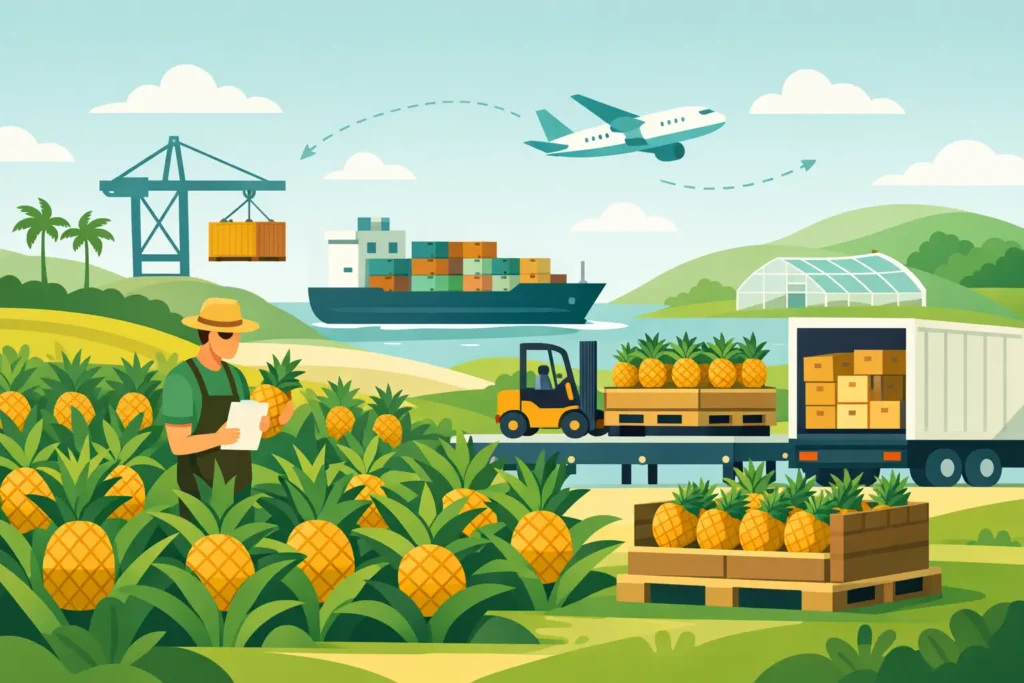
Export pineapple farming is not a hobby crop and it is not a casual land play. A serious guide to pineapple export farming starts with one fact: export-grade production is an operating business, not just a field of fruit. Buyers who understand that difference tend to see the real upside – productive land, managed output, repeatable harvest cycles, and a crop tied to global food demand.
For investors and farm buyers, the appeal is straightforward. Pineapple can produce strong value per hectare, but only when the farm is set up for consistency. Good soil alone is not enough. Export markets reward uniform fruit, disciplined harvest timing, reliable labor, road access, packing logistics, and management that can hold standards across every cycle. That is why turnkey operations stand apart from raw land.
What a guide to pineapple export farming should actually focus on
Most articles start with planting advice. That is too narrow for an export-minded buyer. The more useful question is whether the farm can produce fruit that meets buyer specifications at scale, year after year, without operational chaos.
That shifts attention to the full production model. A farm needs suitable climate, drainage, road connectivity, field planning, labor organization, input control, and oversight that protects margins. In export agriculture, a profitable hectare is built through systems. The fruit is the output of those systems.
This matters even more for absentee owners or international buyers. If ownership depends on being on-site every morning, the investment becomes fragile. A stronger model includes local supervision, contractor-based labor where appropriate, technical crop knowledge, and accounting discipline. That structure reduces execution risk and makes expansion more realistic.
Land selection in pineapple export farming
Not every tropical farm should grow pineapple for export. The crop is productive, but it is demanding. Land must drain well, support mechanized or organized field access, and allow efficient movement from planting blocks to collection and shipment routes. A property with direct road access has a practical advantage because transport delays affect fruit quality, scheduling, and cost.
Topography also affects labor efficiency and field layout. Gently workable land is easier to scale than fragmented or difficult terrain. Buyers often focus on total acreage, but productive acreage is what drives returns. A 67-hectare farm with active production and expansion room can be more commercially valuable than a larger property with weak access or poor field organization.
Water management is another make-or-break factor. Pineapple does not reward neglect. Too much water creates disease pressure and root problems. Too little limits size and uniformity. A strong farm plan accounts for rainfall patterns, drainage behavior, and the practical realities of field maintenance during wet periods.
The business model behind export-grade production
A farm built for export operates differently from a local-market fruit farm. The goal is not simply to harvest pineapples. The goal is to deliver fruit that matches export standards for size, appearance, maturity, and timing. That requires planning from planting onward.
Planting density, varietal choice, fertilization, weed control, disease management, and induction timing all affect whether harvest comes out as a marketable export pack or a margin-eroding mixed lot. Higher output does not always mean better profit. If quality slips, rejection rates rise and labor costs get spread across weaker returns.
This is where established management creates value. A farm with technical oversight and an operating team already familiar with pineapple cycles gives a buyer a meaningful head start. Building that knowledge from zero costs time, cash, and usually a few expensive mistakes.
For commercially minded buyers, the right question is not just what the farm can grow. It is what the farm can consistently sell into the export chain and how much management friction is involved in getting there.
Yield, timing, and expansion potential
Pineapple is attractive because it can generate substantial revenue per planted hectare, but timing matters. Production cycles require capital before harvest, and income does not arrive evenly like a monthly rental property. That does not weaken the opportunity. It simply means the investment should be evaluated as an operating agricultural asset with cycle-based cash flow.
Expansion potential deserves close attention. A farm already producing on part of its acreage but capable of scaling to more hectares can offer a strong balance of proof and upside. Existing production shows the model works. Available expansion acreage creates room for future revenue growth without the need to acquire a second property.
That combination is often more compelling than either extreme. Fully undeveloped land carries more execution risk. A maxed-out farm may offer less room to increase output. Scalable production is where many buyers find the best operating leverage.
Labor, supervision, and cost control
Pineapple farming is labor-sensitive even when the broader model is efficient. Planting, field maintenance, harvest coordination, and post-harvest handling all depend on disciplined execution. Labor is not just a cost line. It is a quality-control line.
The smartest operations do not rely on brute force staffing. They build clear supervision, use contractors where it improves flexibility, and keep accountability tight. That can be especially useful in markets where labor needs rise and fall by crop stage. A contractor-based structure may improve efficiency, but only if management is strong. Without oversight, cost predictability can disappear fast.
For remote owners, local supervision is not optional. It is one of the core assets of the business. A managed farm can protect production standards, reduce shrinkage, keep field tasks on schedule, and give owners cleaner visibility into performance. Agricultural accounting matters here as much as agronomy. If input spending, labor utilization, and harvest results are not tracked well, a productive farm can still underperform financially.
Packing, logistics, and export readiness
A guide to pineapple export farming is incomplete without logistics. Export fruit is judged long before it reaches the consumer. Handling, grading, packing, and transport all influence whether the fruit arrives in saleable condition.
Road access is one of those details that sounds ordinary until it becomes a bottleneck. A farm connected directly to a main road has an advantage in transport reliability and time management. That can help reduce delays between harvest and movement, improve truck access, and support smoother coordination with downstream buyers or exporters.
Export readiness also depends on process discipline. Fruit must be harvested at the correct stage, handled carefully, and moved according to schedule. Quality can be lost after the field if operations are loose. That is why buyers should evaluate the whole chain, not just the crop in the ground.
Risk, margins, and what investors should watch
Pineapple is a compelling crop, but it is still agriculture. Weather variability, disease pressure, input pricing, labor availability, and export market shifts all affect returns. The opportunity is real, but so are the operating variables.
That is exactly why established systems matter. Investors are not buying certainty. They are buying a better risk-adjusted setup. A farm with fertile land, active production, experienced local management, cost oversight, and room to scale is better positioned than a blank property with theoretical potential.
Margin quality matters more than gross revenue headlines. A serious buyer should ask how much acreage is actively producing, what expansion requires in practice, how labor is organized, how accounting is handled, and how quality standards are maintained. Those details often separate a farm that looks attractive on paper from one that performs as a business.
For many buyers, the strongest opportunity is a farm that already operates as an export-oriented enterprise while still leaving room for growth. That is where a property starts to look less like speculative land and more like a disciplined agricultural investment.
Buymyfarm.Co is positioned around exactly that kind of asset – productive tropical farmland with existing pineapple operations, management structure, and scalable commercial potential for buyers who want more than a vacant parcel.
Final thought for buyers evaluating pineapple farms
If you are considering pineapple as an investment, do not ask only whether the land can grow fruit. Ask whether the property already behaves like an export business, or can become one without rebuilding the operation from scratch. In this category, the real premium sits in productive acreage, working systems, reliable supervision, and the ability to scale with control rather than guesswork.