
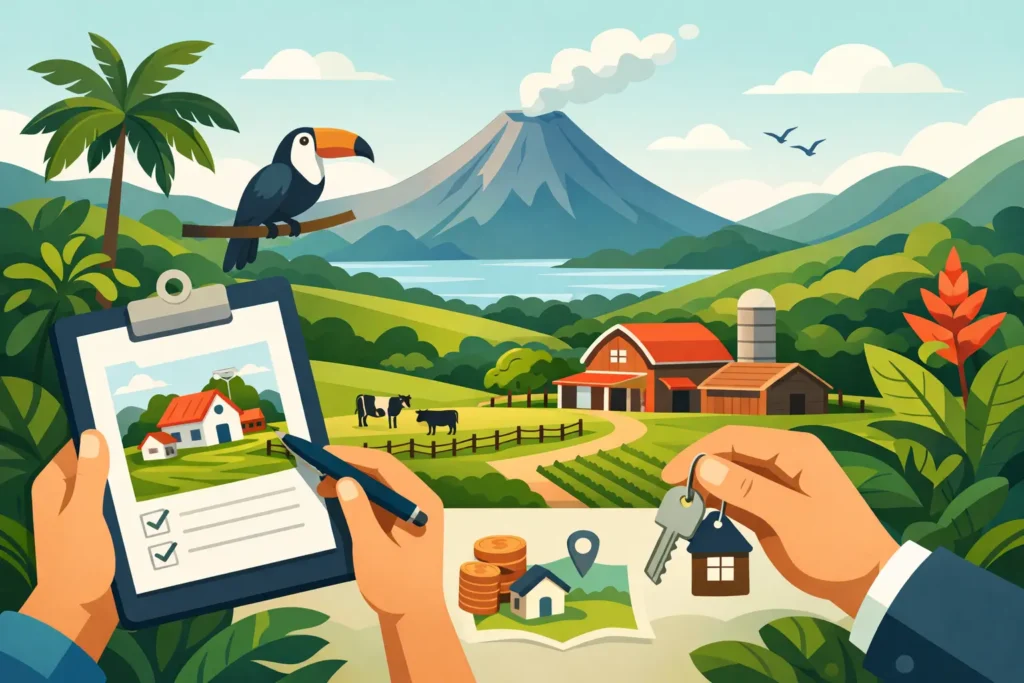
A cheap listing can get expensive fast if the road washes out in rainy season, the water source is weak, or the farm has no real production history. That is why understanding how to buy a farm in Costa Rica starts with one question that matters more than price per acre: are you buying land, or are you buying an operating agricultural business?
For many US buyers, that distinction is where the real opportunity sits. Costa Rica attracts attention for lifestyle, climate, and natural beauty, but serious farmland buyers are usually looking for more than scenery. They want a hard asset, a productive use case, and a clear path to ownership that does not depend on guesswork.
How to buy a farm in Costa Rica with an investor mindset
If your goal is income, the purchase needs to be underwritten like a business acquisition, not treated like a rural real estate impulse buy. A farm can be beautiful and still be a poor investment. On the other hand, a farm with established crop output, direct road access, and room to expand can offer a stronger case than many passive assets, especially when food production is part of the equation.
Start by defining what kind of buyer you are. Some buyers want raw land they can shape over time. Others want a working farm with existing production, local management, and contractor networks already in place. Those are very different purchases. Raw land may have a lower entry price, but it usually comes with more execution risk, more setup cost, and a longer runway before revenue starts.
A productive farm, especially one tied to export-grade agriculture, gives you something measurable on day one. You can review planted area, crop cycle, labor model, yield assumptions, operating costs, and expansion potential. That kind of visibility matters if you are buying from abroad and do not intend to manage every moving part yourself.
Start with the farm’s commercial reality
The first filter is simple: what does the land actually do today? If the answer is “it could be great for farming,” that is speculation. If the answer is “it currently produces a marketable crop with a functioning operating model,” you are in a different category.
A strong farm acquisition usually has a few traits in common. The soil is suitable for the crop being grown. Access is reliable for equipment and transport. Water is available and legally usable. Labor can be organized without building a workforce from scratch. And most importantly, the farm has an economic story that can be tested.
For example, pineapple production is not just about planting acreage. It depends on infrastructure, technical management, planting schedules, harvesting discipline, and export standards. That is why buyers should pay attention to whether a farm already has local supervision, agricultural accounting, and contractor-based labor efficiency. Those are not side details. They are part of the asset.
A turnkey structure can be especially attractive for absentee owners. Instead of spending the first year figuring out local staffing and crop operations, you are stepping into a system that is already designed to produce and scale.
Legal due diligence matters more than enthusiasm
Costa Rica allows foreigners to own property, which is one reason US investors look closely at the market. But ownership access should not be confused with simple execution. You still need disciplined due diligence.
The title history needs to be reviewed carefully. Boundaries, surveys, easements, and any registered liens or encumbrances need to be confirmed by a qualified attorney. If the farm is being sold as an operating business, the buyer should also verify what exactly is included. Land, equipment, crop inventory, management contracts, and operating entities are not always bundled the same way.
Water rights and land use are equally important. A farm without dependable legal access to water is a risk, especially if the crop depends on consistent irrigation or washing processes. Zoning, environmental restrictions, and agricultural use permissions should be checked before you assume future expansion is possible.
This is where inexperienced buyers often lose time and money. They focus on visual appeal and overlook the legal and operational framework that supports actual production.
Evaluate access, logistics, and export practicality
Location is not just about being in a desirable province. It is about how efficiently the farm connects to roads, labor, suppliers, and export channels.
Direct road access has real commercial value. It affects movement of inputs, harvesting schedules, truck access, and wear on equipment. If the property becomes difficult to reach during parts of the year, your margins can suffer quickly. The same is true if transport routes add unnecessary time between the farm and processing or export points.
For buyers interested in crop income, especially fruit production, logistics should be treated as part of the revenue model. A productive hectare is only as valuable as your ability to get that crop to market in saleable condition.
Understand the numbers behind the farm
If you are serious about buying, ask for operating numbers that reflect reality, not marketing language. You want to see the planted hectares, current crop stage, historical yields if available, labor structure, recurring inputs, management expenses, and where margin is expected to come from.
This does not mean every farm needs perfect corporate reporting. Agriculture has moving parts, and results vary by weather, timing, and crop cycle. But there should still be enough financial clarity to understand whether the farm is functioning as a business.
A farm with active production and scalable planting capacity deserves attention because expansion can change the economics. If 20 hectares are already in pineapple production and the land can support up to 35 hectares, that gap matters. It gives a buyer a built-in growth path without starting from zero. Expansion potential is worth more when the road access, land profile, and operating structure are already there.
That is the difference between buying acreage and buying leverage.
Decide whether you want active ownership or hands-off operation
This is where many international buyers need to be honest with themselves. Owning a farm sounds straightforward until you think about crop planning, field supervision, payroll, contractor coordination, accounting, and compliance from another country.
If you plan to live on-site and run the farm personally, your priorities may be different. You may accept more setup work in exchange for lower upfront cost. But if your goal is asset ownership with reduced day-to-day management burden, then local operating support becomes central to the deal.
A well-structured farm investment should not rely on the buyer becoming an agricultural operator overnight. It should have local competence in place, clear reporting, and a system that does not fall apart when the owner is on a plane back to the US.
That is one reason turnkey agricultural investments stand out. They compress the learning curve and reduce execution risk. Buymyfarm.Co positions this model well because it markets productive farmland as both a land purchase and an operating business with on-the-ground structure already built in.
Visit the property, but inspect the system too
Yes, you should walk the land. Look at drainage, topography, field condition, packing and storage areas if any, access roads, and neighboring land use. But do not stop at the physical tour.
Meet the people who make the farm work. Ask who supervises operations, how labor is sourced, how crop decisions are made, and how accounting is tracked. If the farm depends heavily on one individual with no backup or process, that is a risk. If the business has repeatable systems and local accountability, that is far more investable.
You are not just evaluating whether the farm can produce. You are evaluating whether the operation can keep producing under your ownership.
Be clear about your endgame before you close
The best farm purchase is the one that fits your strategy. Some buyers want long-term land appreciation with moderate income. Others want current agricultural cash flow. Others want a second-country asset that also serves as a future family base or lifestyle move.
Costa Rica can support all of those goals, but not with the same property type. A small lifestyle parcel is different from a commercial farm. A raw tract is different from an export-oriented operation. The more honest you are about what success looks like, the easier it becomes to filter out bad deals.
If you are asking how to buy a farm in Costa Rica, the practical answer is this: buy the farm that already proves why it should exist as a business. Fertile land matters. So does climate. But for a serious buyer, the real value is in productive use, legal clarity, operational structure, and room to grow.
That is where a farm stops being a dream purchase and starts becoming a disciplined asset with real upside.