
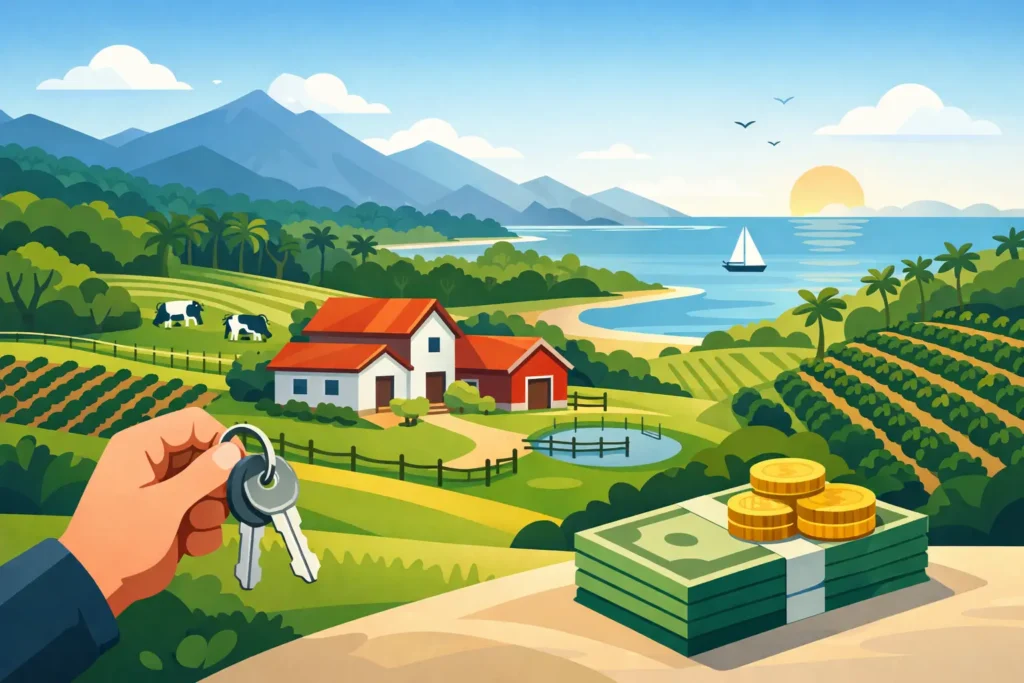
If you are looking at a farm for sale Costa Rica and only asking about acreage, you are probably asking the wrong first question. Serious buyers should start with output, operating structure, expansion capacity, and market access. Land matters, but productive land with a functioning agricultural model is a different asset class entirely.
That distinction is what separates a speculative rural purchase from a working farm business. For investors, entrepreneurs, and buyers who want both ownership and income potential, Costa Rica stands out when the property already has crop production, road access, local oversight, and a path to scale.
What makes a farm for sale Costa Rica worth buying?
A farm becomes compelling when it is already solving the hard problems that usually slow down new owners. Fertile land is valuable, but fertile land with active pineapple production, direct access to a main road, and an established management framework is where the commercial case gets stronger.
The right property is not just a place to own. It is a place that can produce, ship, expand, and be managed without requiring the buyer to rebuild operations from zero. That matters even more for US-based buyers who want agricultural exposure without moving full-time or taking on daily field supervision.
In practical terms, buyers should evaluate four things together: productive hectares, current crop performance, operational control, and future planting potential. When all four line up, the farm has a much better chance of functioning as a real business instead of a high-maintenance landholding.
A productive farm is different from a vacant land play
There is a major difference between buying rural land and acquiring an active agricultural operation. Vacant land can be cheaper up front, but it often carries a hidden startup burden. You need crop planning, labor sourcing, technical advice, accounting control, production timelines, and enough working capital to bridge the gap before harvest revenue arrives.
A producing pineapple farm shortens that path. Existing acreage under cultivation gives a buyer immediate visibility into how the land performs. It also provides a base from which future expansion can be modeled more realistically. For many investors, that reduction in uncertainty is worth more than a lower purchase price on undeveloped land.
That is especially true in export-oriented agriculture. Pineapple is not a casual crop. Quality standards, timing, field management, and post-harvest discipline all affect margin. A property with established systems already in place gives the buyer a far stronger starting position.
Why pineapple production changes the investment profile
Pineapple is one of the clearest ways to move a farm from passive holding to revenue-focused asset. It is a crop with established international demand, and in the right location it benefits from climate, soils, and commercial familiarity. Costa Rica has built a strong reputation in this category, which is one reason informed buyers continue to watch the sector.
Still, not every pineapple property offers the same value. Buyers should look beyond the headline crop and ask how much land is currently planted, whether the layout supports expansion, and whether the operating model has enough discipline to protect margins. Production without oversight can become expensive very quickly.
A farm with nearly 20 hectares already in active pineapple production and room to scale up to 35 hectares offers a more attractive profile than a property with only theoretical potential. Current production shows capability. Expansion capacity creates upside. Together, they give a buyer both evidence and optionality.
The operational details serious buyers should care about
A commercially sound farm purchase is built on more than soil and rainfall. It depends on how the business is run on the ground. This is where many listings fall short. They sell the dream of farm ownership but leave the buyer to solve management after closing.
A stronger model includes local supervision, technical crop expertise, agricultural accounting oversight, and contractor-based labor efficiency. Those details are not cosmetic. They directly affect whether absentee ownership is practical and whether the business can stay organized through planting, maintenance, harvest, and cost control.
For a US investor, this matters because the ideal purchase is not a second full-time job. The best farm investments create distance between ownership and day-to-day operational friction. That does not mean hands-off forever. It means the structure is already in place to support informed ownership rather than emergency management.
An established management framework also makes performance easier to track. Buyers can evaluate not only the land, but the operating logic behind it. That is a much stronger foundation for decision-making than buying acreage and hoping the local setup can be assembled later.
Land size, access, and scalability
A 67-hectare farm with fertile ground and direct road access to the main road has immediate commercial advantages. Access affects input delivery, labor movement, harvest logistics, and transport efficiency. In farming, friction costs money. Better access usually means smoother execution.
Scale matters too, but it should be productive scale. Large acreage that is difficult to use or manage does not create value by itself. By contrast, a property with active production and clear room to increase planted area allows buyers to think in phases. You can operate the existing planted area, review performance, and expand with greater confidence.
That phased path is valuable because it gives buyers options. Some may want stable output first and gradual growth later. Others may see unused planting capacity as the main upside case. Both approaches can make sense, depending on risk tolerance, capital allocation, and timeline.
Why turnkey structure appeals to international buyers
Many US buyers are attracted to Costa Rica farmland because it combines hard-asset ownership with food-sector exposure and geographic diversification. But interest often stalls when the buyer realizes how much infrastructure is needed to turn raw land into a functioning agribusiness.
That is why turnkey agricultural structure has real value. When a farm comes with operating systems, field knowledge, and management support, the buyer is not starting from scratch. The purchase becomes easier to model as a business. It also reduces the usual transition risk that comes with cross-border ownership.
This does not eliminate all risk. Agriculture always carries variables, including weather, market pricing, input costs, and crop performance. But a disciplined operating setup helps contain avoidable mistakes. For serious investors, that is a meaningful difference.
The trade-off between lifestyle appeal and business discipline
Costa Rica is easy to romanticize. The climate, scenery, and land ownership appeal are real. But buyers looking for a farm for sale Costa Rica should be honest about their primary objective. If the goal is income, then business discipline has to lead the evaluation.
That means reviewing crop economics, management capability, planted hectares, and scale potential before getting distracted by the lifestyle angle. The strongest farm purchases are the ones that still make sense after the excitement wears off and the numbers remain attractive.
Of course, the appeal of owning productive tropical farmland is part of the value. A well-positioned farm can be both aspirational and commercially rational. The key is buying an asset that earns its place in your portfolio, not just one that looks good in a brochure.
What a serious buyer should look for next
A credible opportunity should show clear operational facts, not vague promises. Buyers should want to know how much acreage is currently productive, what the management structure looks like, how labor is organized, how financial oversight is handled, and where expansion can occur. If those answers are thin, the opportunity probably is too.
This is also where a focused seller stands apart from a generic land marketplace. A business built around direct property marketing, profitability metrics, crop value, and operational specifics speaks the language serious buyers need. Buymyfarm.Co fits that approach by framing the asset as a working farm investment, not just a parcel on a map.
For entrepreneurs and investors who want exposure to export-grade agriculture, a producing pineapple farm in Costa Rica offers a straightforward proposition. You are not simply buying land. You are acquiring fertile acreage, current production, a management structure, and room to grow.
The best farm purchases are the ones that make sense on paper before they become satisfying to own. If you find a property that already produces, already operates, and still has room to expand, that is where the conversation gets interesting.