
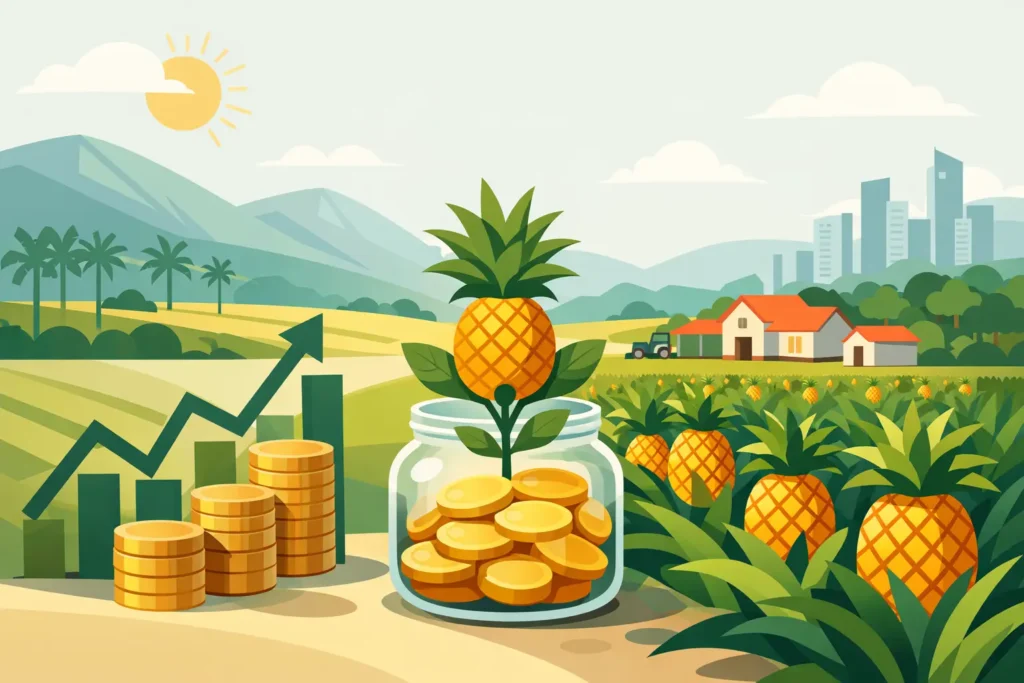
A serious pineapple farm investment is not about buying tropical land and hoping the market stays favorable. It is about acquiring a producing asset with known acreage, active crop cycles, labor structure, road access, and a clear path to scaling revenue. For buyers looking at farmland as a business, pineapple stands out because it combines export demand, repeat production planning, and the value of owning a hard asset tied to food supply.
That is where the difference lies between raw land and an operating farm. Raw land may be cheaper on paper, but it usually comes with setup risk, timeline delays, staffing gaps, and early-stage capital demands. A producing pineapple farm starts from a more commercial position. You are evaluating output, margins, systems, and expansion potential rather than just location and soil.
Why pineapple farm investment gets investor attention
Pineapple is not a novelty crop. It is part of a global produce trade with established buyer demand, logistics channels, and quality standards. That matters for investors because crops linked to real distribution networks tend to offer a more disciplined path to revenue than speculative agricultural ideas.
There is also a practical advantage in the crop itself. Pineapple production can be planned at scale, managed in blocks, and measured in commercial terms that serious buyers understand – planted hectares, harvest cycles, labor efficiency, crop value, and marketable yield. For an investor, that makes underwriting the opportunity more concrete.
Costa Rica adds another layer to the case. The country has an established agricultural reputation, export familiarity, fertile land, and a climate suited to year-round production planning. For US-based buyers who want international diversification without stepping into an untested farming environment, that combination is appealing.
What separates a real pineapple farm investment from a land listing
The strongest opportunities are not simply parcels where pineapple could be grown. They are businesses already built around pineapple production. That means existing planted area, operating supervision, contractor-based labor, accounting oversight, and the technical knowledge required to maintain crop quality.
This distinction is critical for absentee owners and first-time farm buyers. If you live in the US and want a producing agricultural asset in Costa Rica, the biggest question is not whether the land is fertile. It is whether the operation can continue performing without requiring you to build management from scratch.
A turnkey structure changes the risk profile. Instead of hiring your first local team, designing your crop plan, and learning production timing through trial and error, you step into an organized operation with active output and a working business model. That does not eliminate risk – agriculture never offers that – but it does remove much of the startup uncertainty that hurts new farm owners.
The numbers behind commercial pineapple production
A pineapple investment should always be viewed through operating metrics, not just acreage. Hectares under active production matter more than total farm size if your goal is current income. At the same time, total land size still matters because unused or underused acreage may represent future production growth.
That is one reason a property with 67 hectares, nearly 20 hectares already in pineapple production, and scalable planting capacity up to 35 hectares stands out commercially. It gives an investor both present activity and future upside. You are not buying only what the farm is today. You are also buying what the farm can become with disciplined expansion.
Road access is another operational detail buyers should treat as a financial variable. Direct access to a main road supports labor movement, crop transport, input delivery, and export logistics. A beautiful farm with weak access can quietly erode margins. A commercial farm with strong access tends to operate more efficiently and communicate better with buyers, contractors, and shipping channels.
When investors assess a producing pineapple property, they should look closely at revenue per planted hectare, cost controls, harvest timing, contractor use, and crop quality standards. The point is not to chase an idealized return model. The point is to understand whether current production is disciplined and whether expansion can happen without breaking the operating system.
Pineapple farm investment works best with management already in place
Many land buyers like the idea of farm ownership but do not want to become full-time operators. That is entirely rational. Pineapple is a commercial crop, not a casual weekend project. It requires field planning, supervision, labor coordination, and attention to harvest quality.
This is why farm management structure is one of the most valuable parts of the investment. Local supervision keeps operations moving. Agricultural accounting oversight gives buyers visibility into costs and performance. Contractor-based labor can improve efficiency by keeping staffing aligned with actual field needs rather than carrying unnecessary fixed overhead. Technical crop expertise helps protect quality, consistency, and export standards.
In simple terms, management determines whether the farm functions like a business or behaves like a burden. Buyers who ignore this usually overestimate how easy agricultural ownership will be. Buyers who prioritize it tend to make better investment decisions.
Where the upside comes from
The upside in a pineapple farm investment usually comes from four drivers: productive land value, crop income, operational efficiency, and expansion capacity. A farm that is already producing has one kind of value. A farm that can increase planted area under an existing management structure has another.
That expansion potential matters because adding hectares can improve the economics of the operation if the underlying systems are already in place. The important phrase is if the underlying systems are already in place. Scaling a weak operation often creates larger problems. Scaling a disciplined one can improve returns and strengthen the business.
Export-oriented production also creates a more serious investment profile. Export-grade output typically requires stronger standards, but it also places the farm in a more commercially mature market environment. Buyers interested in food-sector assets often prefer that structure because it aligns the farm with a broader supply chain rather than a narrow local sales model.
There is also a portfolio argument here. Productive farmland can serve as a tangible hedge against purely financial assets. It is still an operating business, so it comes with execution risk, weather exposure, and commodity dynamics. But unlike abstract instruments, it is a real asset with land, infrastructure, output, and intrinsic use value.
The trade-offs smart buyers should consider
No credible article on pineapple farm investment should pretend the opportunity is risk-free. Pineapple is attractive because it is a real business, and real businesses require discipline. Weather events, labor availability, crop performance, export market conditions, and input costs all affect results.
There is also the question of buyer fit. Some investors want maximum passivity and should be honest about that. Even with management in place, farmland ownership still requires oversight, decision-making, and periodic review of operating performance. If you want zero involvement, this may not be the right asset class. If you want a tangible business with management support and measurable production, it becomes much more compelling.
Expansion is another area where judgment matters. More planted hectares can increase revenue, but only if water, labor, supervision, crop timing, and market strategy are aligned. Growth is valuable when it is controlled. Growth for its own sake can pressure margins.
Who this opportunity fits best
The best buyer for a producing pineapple farm is usually not a hobby farmer. It is an investor, entrepreneur, or internationally minded land buyer who wants ownership backed by operating logic. This buyer understands that a farm can be both an aspirational purchase and a disciplined commercial asset.
For many US buyers, Costa Rica adds lifestyle appeal, geographic diversification, and confidence in an established agricultural setting. But the stronger case is still business-first. If the farm has fertile land, active production, direct road access, scalable acreage, and an existing management framework, it deserves attention as an income-producing asset rather than a speculative land play.
That is the position a platform like Buymyfarm.Co is built to present – not just farmland for sale, but a functioning agricultural business with room to grow.
The right pineapple farm investment gives you more than acreage. It gives you a producing operation, a structure for absentee ownership, and a realistic way to participate in a food-driven asset class without starting from zero. If you are looking for tropical land, buy land. If you are looking for a business, buy the farm that is already working.