
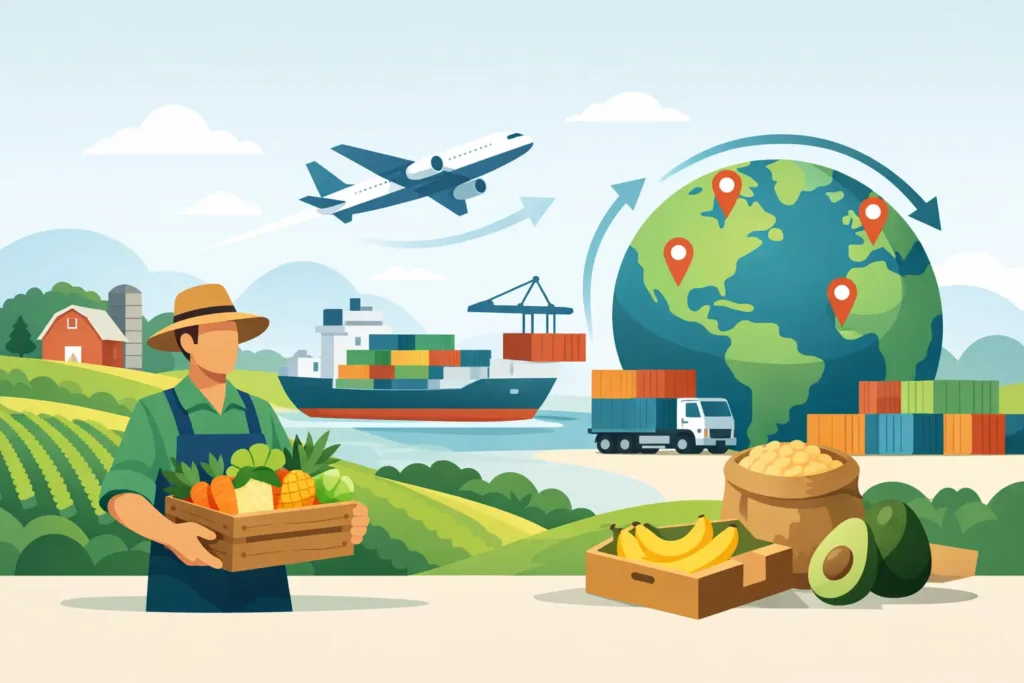
A farm that produces for local sale is one thing. An export farming business is a different asset class entirely. It has to meet stricter quality standards, move product on schedule, protect margins against logistics and labor swings, and keep production consistent enough to satisfy buyers who care about volume as much as appearance. For investors and farm buyers, that changes the conversation from owning land to owning a working agricultural enterprise.
That distinction matters if you are evaluating tropical farmland in Costa Rica or any other production region with year-round growing advantages. Export-oriented farming is not simply about planting a profitable crop. It is about pairing productive acreage with an operating model that can deliver marketable fruit, disciplined cost control, and room to scale without rebuilding the business from scratch.
What makes an export farming business different
The strongest export farms are built around repeatable systems, not just good soil. Fertility matters. Rainfall matters. Road access matters. But the commercial value comes from how those advantages are organized into output that can meet buyer expectations over time.
An export operation has less room for improvisation than a small domestic farm. Crop timing affects shipment windows. Fruit quality affects acceptance rates. Labor has to be coordinated around planting, maintenance, and harvest cycles. Financial oversight has to be good enough to track margin per hectare, not just gross sales. If one part of the chain underperforms, the whole model feels it.
That is why experienced buyers look beyond acreage and ask harder questions. Is there active production already in place? Is management local and accountable? Is there technical crop knowledge on the ground? Is labor structured efficiently, or is the business carrying unnecessary overhead? These are not side details. They are the difference between owning a farm and acquiring a producing business.
The economics of an export farming business
The attraction is straightforward. A well-run export farming business can combine land ownership, agricultural income, and food-sector exposure in one investment. That has obvious appeal for buyers who want tangible assets with operating revenue rather than passive land held only for appreciation.
Still, the economics depend on execution. Export-grade agriculture rewards scale and efficiency, but it also punishes weak management. A farm with fertile land but no operating discipline can leak value through inconsistent yields, poor labor planning, or harvest losses. On the other hand, a farm with established production, contractor-based field efficiency, and crop-specific technical oversight can protect margins much more effectively.
This is where pineapple stands out. It is a crop with proven export demand, and in the right location it offers a clear commercial framework. But not every pineapple farm is equal. The better opportunities are farms where active hectares are already producing, the infrastructure supports transport, and the property can expand planted area without major structural changes. Buyers are not just purchasing current output. They are purchasing the ability to increase revenue from a system that already works.
Why scale matters in export farming
A small farm can be productive and still fall short as an investment. Export markets favor operations that can deliver enough volume to justify logistics, labor coordination, and quality management. That does not mean every buyer needs a massive plantation. It means the asset should have enough planted area and expansion potential to improve operating leverage over time.
For example, a property with active production on roughly 20 hectares and scalable planting capacity up to 35 hectares has a stronger commercial case than a farm already maxed out at its current footprint. Expansion potential gives the owner options. You can grow output as market conditions justify it, spread fixed management costs across more productive land, and increase the value of the operation without searching for another property.
That optionality matters to serious investors. It lowers one of the biggest friction points in agriculture – having to assemble land, staffing, crop planning, and supervision from zero. A farm that is already structured for export output offers a shorter path to commercial scale.
The role of management in an export farming business
Absentee ownership is one of the most attractive features in this segment, but only when the operating model supports it. Many buyers want exposure to farmland and agricultural revenue without managing day-to-day field operations themselves. That is realistic only if the farm includes local supervision, financial oversight, and crop expertise that can keep production disciplined.
This is often where listings become weak. Some properties are marketed as opportunities, but the buyer is really purchasing raw potential and a future workload. That can still work for operators who want to build from the ground up. It is far less appealing for an investor who prefers a business asset with established controls.
A turnkey export farming business is different. It gives the buyer a functioning framework: local farm supervision, agricultural accounting oversight, contractor-based labor efficiency, and technical know-how specific to the crop. Those elements reduce transition risk. They also make the operation more legible from an investment perspective because the farm is not relying on guesswork or heroic owner involvement.
Risk is real, but it can be managed
No credible farm investment pitch should pretend agriculture is risk-free. Weather, disease pressure, labor availability, export pricing, and transportation costs all affect outcomes. Crop businesses live with biological uncertainty, and export-focused operations face additional pressure from timing and market standards.
The practical question is not whether risk exists. It is whether the property and management structure are set up to handle it well. Road access reduces transport friction. Established production history gives buyers a clearer read on performance. Experienced supervision improves crop consistency. Contractor-based labor can help keep staffing more flexible than a bloated permanent payroll. Expansion potential provides room to improve returns without changing the entire business model.
There is also a portfolio argument here. For many US-based buyers, tropical farmland offers geographic diversification along with exposure to food production, which tends to remain relevant in every market cycle. That does not eliminate volatility, but it changes the nature of the investment. You are not buying a concept. You are buying land, crop output, and an operational system tied to a basic global need.
What serious buyers should look for first
If you are assessing an export farming business, start with current production and net operational logic, not headline acreage alone. A large property can sound impressive while underperforming commercially. A better asset shows productive hectares, realistic room for growth, and a management structure that supports consistency.
Look closely at how the labor model works. Farms that rely on efficient contractors often have more flexibility than operations burdened by permanent staffing mismatched to production cycles. Review whether there is direct access to major roads, because transport delays and handling inefficiencies can erode value quickly in export crops. Ask how accounting is managed and whether performance is tracked in a way that helps ownership make decisions based on numbers instead of assumptions.
Most importantly, understand whether the farm is truly export-oriented or simply using that language as a selling point. Export-grade production is visible in the operating design. It shows up in planting discipline, harvest planning, quality control, and the presence of people who know how to run the crop commercially.
Why this model fits today’s buyer
Many buyers in the US market want more than speculative land. They want a hard asset that can produce income, hold intrinsic value, and operate within an industry they understand at a basic level. Food production is easy to grasp. Fertile land is finite. A professionally structured tropical farm can sit at the intersection of both.
That is why an export farming business has gained traction with entrepreneurial buyers and internationally minded investors. It offers a practical middle ground between purely passive ownership and full hands-on farm building. You still own the land. You still benefit from agricultural upside. But you are entering through an operating platform rather than a blank slate.
For buyers reviewing a property like the kind presented by Buymyfarm.Co, that is the real value proposition. You are not just acquiring hectares. You are stepping into a business with active production, road access, management structure, crop expertise, and credible expansion capacity.
The best farm investments usually look simple from the outside because the hard work of structuring them has already been done. That is exactly what makes them worth a closer look.