
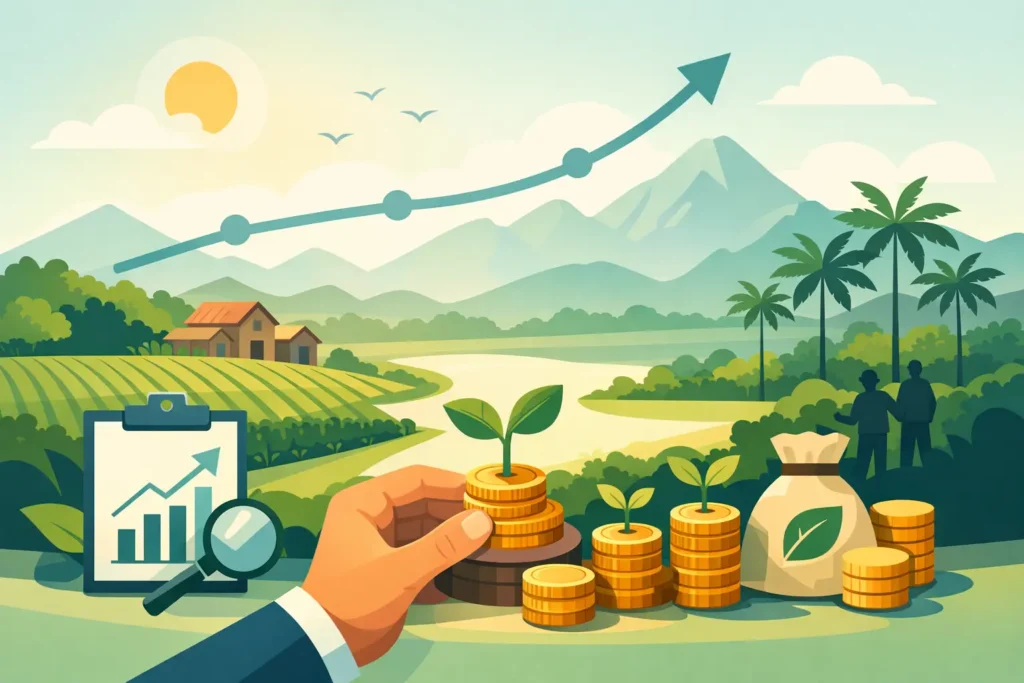
A vacant parcel in the tropics is one thing. A producing farm with roads, labor access, crop expertise, and room to scale is something else entirely. That difference is what makes tropical farmland investment worth serious attention from buyers who want more than land appreciation and are looking for a real operating asset.
For US investors, the appeal is straightforward. Productive tropical land can generate revenue from crops, benefit from year-round growing conditions, and serve as a hard asset in a sector tied to food demand rather than market sentiment. But the best opportunities are not built on climate alone. They are built on execution, crop choice, infrastructure, and management.
What makes tropical farmland investment attractive
The strongest case for tropical farmland investment starts with biology and economics working together. In the right region, tropical farmland can support multiple production cycles, faster crop development, and a wider range of high-value crops than many temperate markets. That creates a different return profile from row-crop land in North America, where seasonality can limit output and flexibility.
There is also a diversification argument that matters to experienced buyers. Farmland behaves differently from stocks, office real estate, or speculative development projects. Add international exposure and export-oriented agriculture, and the asset becomes even more distinct. For investors concerned about concentration risk, owning productive land in a stable agricultural corridor can be a rational move.
That said, not all tropical farms deserve the same valuation. The phrase sounds promising, but returns come from specific operating realities. Soil quality, water access, road frontage, labor structure, proximity to export channels, and crop management discipline all shape performance. Tropical conditions can increase opportunity, but they also punish weak operations fast.
Productive farmland beats raw land
This is where many buyers make the wrong comparison. They evaluate a producing farm against bare land on a price-per-acre basis and miss the actual business value. A turnkey agricultural property may include established planting areas, local supervision, technical crop knowledge, accounting controls, contractor relationships, and a clear production model. Those components reduce startup friction and shorten the time between acquisition and cash flow.
Raw land can look cheaper, but cheap land often becomes expensive once you factor in land prep, planting, labor recruitment, infrastructure, trial-and-error crop decisions, and management gaps. If the buyer is based in the US and not planning to live on the farm full time, those gaps are not minor. They are often the difference between a functioning agribusiness and an underperforming asset.
A serious tropical farmland investment should be evaluated as an operating platform. If there is active production, export-grade standards, and room to expand without reinventing the business, that carries real value. Buyers who understand this usually focus less on the headline land price and more on the ability of the farm to maintain output and grow it efficiently.
Why crop selection matters more than the dream
There is a romantic version of overseas farm ownership, and then there is the practical version. The practical version starts with the crop. Some crops are more forgiving, some are more labor-intensive, and some have stronger export logic than others. A good farm business is not simply located in the tropics. It is aligned with a crop that fits the soil, infrastructure, market demand, and labor model.
Pineapple is a useful example because it shows how a tropical asset can move beyond land ownership into commercial production. Export-grade pineapple operations require more than fertile ground. They need production planning, quality control, timing, technical oversight, and market awareness. When those systems are already in place, a buyer is not just acquiring acreage. The buyer is stepping into an established business model with a clearer path to revenue.
That does not mean every tropical fruit farm is automatically a good investment. Monocrop exposure, price swings, weather pressure, and operational inconsistency can all affect returns. But if the farm has active production, proven crop performance, direct road access, and additional plantable area, the upside becomes easier to quantify.
The real drivers of return in tropical farmland investment
Buyers often ask whether the return comes from land appreciation or crop income. The honest answer is that it depends on the property, but income is what gives the asset commercial strength. Appreciation can be meaningful over time, especially in desirable agricultural regions, yet relying on appreciation alone turns farmland into a passive land bet rather than a business purchase.
The more durable investment thesis usually combines three layers. First, there is the underlying land value. Second, there is current crop revenue from active acreage. Third, there is expansion potential if more hectares can be planted under the same operating structure. When all three exist together, the property has a stronger investment profile than land that only offers future possibility.
This is one reason scalable farm layouts matter. A farm with 20 hectares in active production and the ability to expand to 35 productive hectares is not simply larger on paper. It offers a path to increasing output without starting from zero. Existing access roads, labor relationships, and management systems can support that growth more efficiently than a new project launched on undeveloped land.
Management is where absentee ownership succeeds or fails
Many US buyers are interested in owning farmland abroad but do not want a second full-time job. That is reasonable, and it is exactly why operating structure deserves as much attention as crop performance. Tropical farmland investment becomes more attractive when local supervision, agricultural accounting oversight, contractor-based labor, and technical farm expertise are already part of the business.
Without that structure, remote ownership can quickly become reactive and expensive. Inputs get mismanaged, labor becomes inconsistent, harvest timing slips, and reporting loses credibility. A farm may still produce, but it will not produce with the discipline investors expect.
This is where a turnkey model has a practical advantage. A buyer can enter with clearer visibility on operating costs, workflow, and production standards. That does not eliminate risk, but it does reduce startup uncertainty. For commercially minded investors, that reduction in execution risk is a major part of the value.
Costa Rica deserves a hard look
Location always matters, and Costa Rica stands out because it offers more than tropical weather. Buyers are looking at a country with a strong agricultural identity, export familiarity, and broad international recognition. For farmland investors, that combination matters because agriculture performs best where logistics, labor knowledge, and crop history already exist.
Within that setting, farm-specific details become decisive. Fertile acreage, direct access to a main road, and operational readiness can significantly improve business performance. A tropical farm that is isolated, difficult to service, or heavily dependent on new infrastructure carries a very different risk profile from one that is already positioned for production and transport.
This is why opportunity in Costa Rica is not just about owning land in a desirable country. It is about owning productive land with a credible path to revenue. For the right buyer, that means a farm can serve as both a hard asset and a working agribusiness.
What serious buyers should look for
When evaluating tropical farmland investment, the best questions are commercial, not cosmetic. How many hectares are actively producing today? What crop systems are already working? Is the farm built for export-grade output or just local sales? What does the labor model look like? Is there local management in place? Can production scale without major new overhead?
These questions cut through marketing language and get to the actual asset. A beautiful property is not necessarily a strong investment. A profitable farm, on the other hand, can still be attractive even if the story is plain. Sophisticated buyers know that yield, access, systems, and expansion capacity matter more than lifestyle imagery.
That is also why some of the strongest opportunities are niche and operationally specific. A farm business with fertile land, active pineapple production, scalable planting capacity, and established management support can appeal to buyers who want agricultural income without building the entire platform themselves. In that sense, Buymyfarm.Co is speaking to a very particular kind of investor – someone who wants ownership, output, and a business model in one acquisition.
Tropical farmland investment is not for buyers chasing a simple postcard purchase. It is for buyers who understand that the right farm can produce food, cash flow, and long-term asset value at the same time. If you focus on production quality, management depth, and expansion logic, the opportunity becomes much clearer. The smartest farmland purchases are usually the ones that already know how to work before you arrive.