
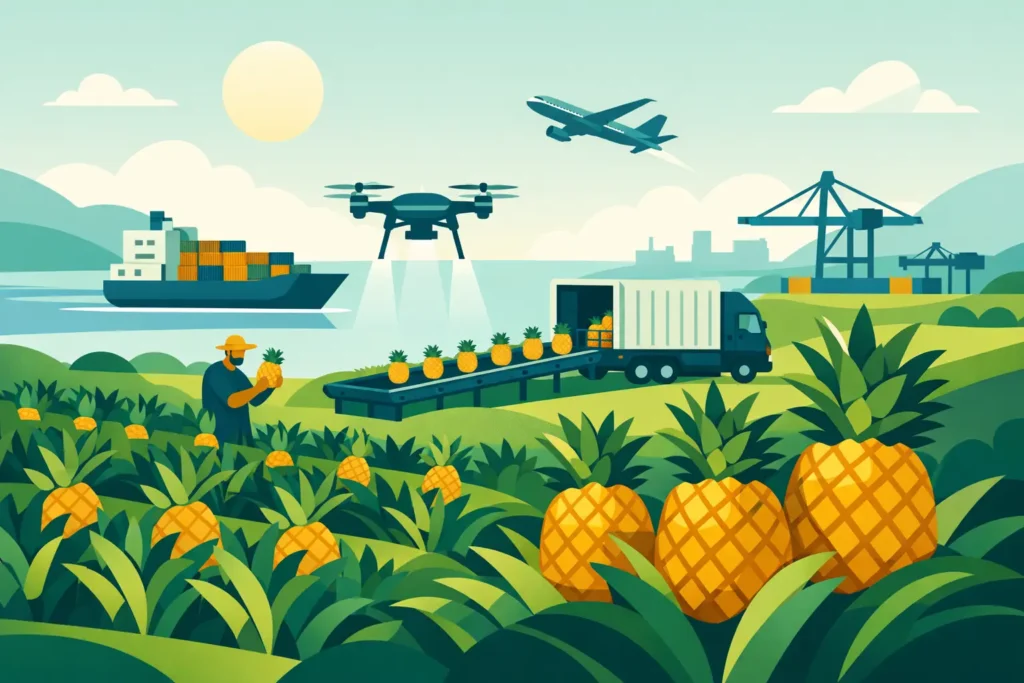
Export markets do not reward pineapple farming equally. They reward consistency, fruit quality, logistics, and management discipline. That is why the future of export pineapple farming will favor operations that are already built for commercial scale, cost control, and reliable shipment standards rather than small farms trying to improvise their way into global supply chains.
For investors, that distinction matters. Pineapple remains one of the most commercially attractive tropical crops in international produce, but the real opportunity is no longer just owning land that can grow fruit. The stronger position is owning a farm business that can produce export-grade fruit, expand efficiently, and operate with systems that support absentee ownership and measured scaling.
What the future of export pineapple farming will reward
The next phase of export pineapple farming will be shaped by tighter buyer expectations and sharper competition. Importers and distributors want dependable volume, uniform fruit, predictable harvest timing, and farms that can maintain production standards without operational chaos. In practical terms, that shifts value toward professionally managed farms with established planting programs, labor coordination, technical oversight, and road access that supports movement from field to export channels.
This is where scale starts to matter in a very specific way. Bigger is not always better, but scalable is better. A farm with active production and additional plantable area has a clear advantage because expansion can happen from an existing base instead of starting from zero. That lowers the learning curve, shortens time to revenue growth, and gives the owner more flexibility in timing future planting blocks.
A 67-hectare farm with nearly 20 hectares already in pineapple production and room to scale toward 35 hectares is not simply raw agricultural land. It is an operating platform. That difference will become even more valuable as export standards keep favoring farms that can combine land, crop output, and management structure in one business asset.
Why export-grade operations are separating from basic farmland
There is a growing gap between land ownership and farm ownership. Owning fertile land in a tropical region is attractive, but export agriculture demands more than good soil and weather. It requires field planning, crop supervision, labor organization, input control, accounting discipline, and local execution. Farms that already have those pieces in place are in a different category from undeveloped properties.
That is one of the clearest signals in the future of export pineapple farming. Buyers are not just assessing acreage. They are assessing operational readiness. Can the farm produce fruit that meets export expectations? Can it maintain crop quality across larger planted areas? Can it support an owner who does not want to manage daily field issues personally?
For many investors, the answer determines whether a farm is an asset or a project. Projects consume time, create uncertainty, and often delay returns. Assets with an established operating model can move much faster, particularly when there is already local supervision, contractor-based labor efficiency, and technical crop knowledge on the ground.
Cost control will matter as much as yield
Pineapple farming often gets marketed around revenue potential, but experienced buyers know the stronger metric is margin. High production means little if labor is inefficient, field execution is inconsistent, or logistics become expensive and disorganized. Export farming is a business of controlled repetition. The farm that wins is not always the one with the highest gross output. It is often the one that manages cost per hectare, harvest timing, and quality losses more effectively.
That is why contractor-based labor models and agricultural accounting oversight are becoming more important. They create discipline around labor deployment and operating expenses. They also make the business easier to evaluate from an investment standpoint because the owner can track performance with more confidence.
There is a trade-off, of course. Intensive management systems require structure and accountability. They are not passive by default. But they are far more investable than loosely run operations where production decisions depend on informal routines and inconsistent supervision.
Infrastructure is not glamorous, but it drives export value
One of the most overlooked factors in pineapple investment is access. Direct road access to the main road may not sound exciting in a listing, but it has real financial impact. Moving labor, inputs, equipment, and harvested fruit efficiently improves timing and reduces friction across the entire operation. In export agriculture, delays create losses quickly.
The same logic applies to layout and expansion capacity. If additional hectares can be planted without reinventing field logistics, the owner is not just buying more land. The owner is buying more usable production capacity. That distinction is critical when evaluating how future revenue can be grown.
In this market, practical infrastructure supports commercial credibility. Export buyers and investors both value operations that can move product reliably. A farm does not need luxury features. It needs efficiency in the field and on the road.
The role of scalability in future returns
Not every farm needs to maximize every hectare immediately. In fact, disciplined expansion is usually smarter than aggressive planting without support systems. But having the capacity to grow from 20 hectares of active pineapple production toward 35 hectares creates strategic upside. It allows owners to match expansion to market conditions, capital plans, and operating confidence.
That flexibility is a major part of the investment case. A scalable farm gives the buyer more than present income. It provides optionality. You can keep production at current levels and focus on stable operations, or you can increase planted area to pursue larger export volume and stronger long-term earnings.
For US-based investors looking at agricultural assets abroad, this matters because timing is rarely one-size-fits-all. Some buyers want a productive farm that is already working and needs minimal intervention. Others want room to build value through phased expansion. The better farm business can accommodate both approaches.
Management quality is becoming the real differentiator
As more buyers look at farmland as an alternative investment, the conversation often starts with location and crop. It should quickly move to management. Pineapple exports are not won by land alone. They are won by execution.
That includes local supervision that keeps field work on schedule, technical expertise that supports crop health and fruit quality, and accounting systems that give the owner visibility into performance. For absentee owners, this is not a side detail. It is the difference between owning an operating business and owning a distant problem.
This is why turnkey agricultural assets are gaining attention. A farm that combines productive land with a functioning management structure is easier to underwrite and easier to scale. It also reduces one of the biggest barriers to entry for international buyers, which is the need to build local operational capacity from scratch.
Why Costa Rica remains well positioned
Costa Rica continues to stand out for export-oriented pineapple production because it offers the combination investors actually need: fertile land, established agricultural know-how, and access to export markets through a country already recognized for commercial agriculture. That does not mean every farm is automatically a strong investment. It means the region supports the right kind of business if the property itself has the right operating profile.
For buyers in the US market, there is also a broader appeal. Productive farmland in Costa Rica can serve as an income-generating asset, a diversification play, and a tangible entry into the food sector. When that land comes with active production and a management model designed for commercial output, the opportunity moves beyond lifestyle appeal and into disciplined agribusiness ownership.
A platform like Buymyfarm.Co speaks directly to that buyer because it presents farm ownership as both aspiration and measurable business performance. That framing fits where the market is heading.
The future of export pineapple farming is built, not imagined
The farms likely to benefit most from the next decade of export demand are not speculative concepts. They are properties with fertile acreage, active production, expansion room, road access, and an operating system that already supports export-grade output. Those are the assets that give investors a realistic path to revenue, scale, and long-term value.
There will always be a place for development-stage farmland, and some buyers prefer the lower entry cost and the freedom to build their own systems. But for investors focused on execution, timing, and risk-adjusted opportunity, established pineapple operations with room to grow are in a stronger position.
If you are evaluating this sector seriously, look past the crop headline and study the business underneath it. The best opportunities in export agriculture are rarely the cheapest land. They are the farms that are already prepared to perform when the market asks for more.