
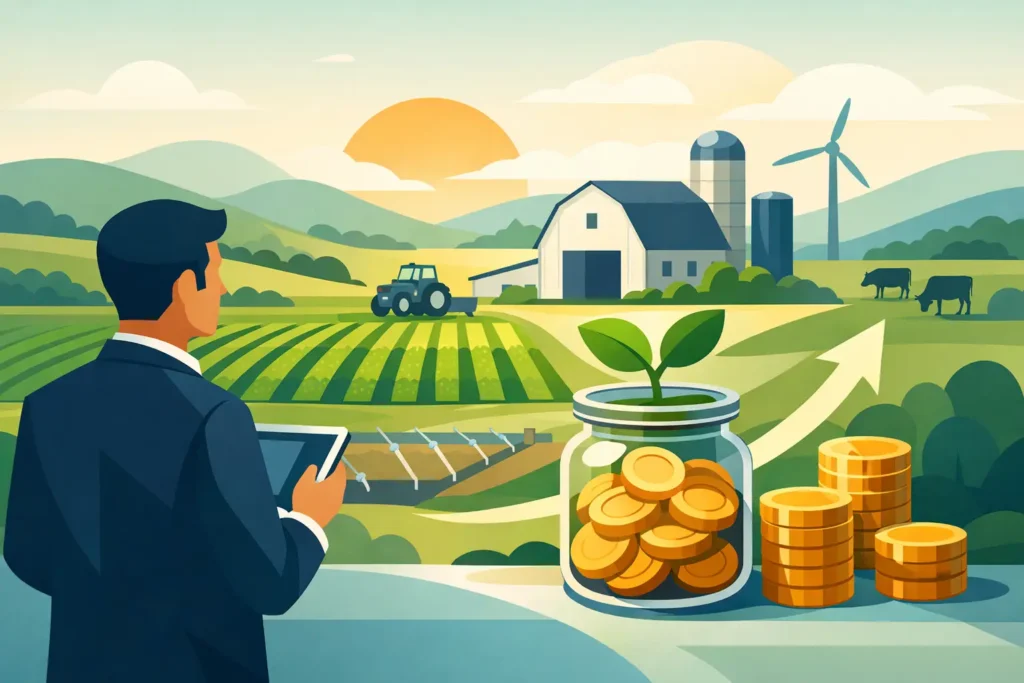
Most absentee ownership fails for a simple reason: the buyer acquires land, not an operating business. An absentee owner farm investment only works when the farm is already structured to run without daily owner involvement, with crop planning, supervision, accounting, and labor coordination built into the model.
That distinction matters more in agriculture than in almost any other asset class. Farmland can be a strong store of value, but productive farmland is where the real upside begins. If the property already has active production, road access, local oversight, and room to scale, the buyer is not starting from zero. They are stepping into an income-producing operation with a clearer path to returns.
For US-based investors looking at Costa Rica, this is where the opportunity gets interesting. Tropical farmland offers exposure to food production, export markets, and hard-asset ownership in a region with year-round growing conditions. But none of that is enough on its own. The real question is not whether the land is fertile. It is whether the business can perform while the owner is somewhere else.
What makes an absentee owner farm investment work
A true absentee model starts with operational design. If the farm depends on the owner to source labor, manage planting schedules, negotiate every purchase, and monitor every field decision, it is not absentee-friendly. It is owner-dependent.
A better model is built around local management and repeatable systems. That means someone on the ground is supervising work, technical crop decisions are informed by experience, labor is organized efficiently, and finances are tracked with enough discipline to show what the farm is actually producing. Without that structure, absentee ownership turns into remote problem solving, which is usually expensive.
This is why operating farms attract a different class of buyer than vacant land. The land still matters, of course. Soil quality, water access, terrain, infrastructure, and logistics all affect value. But for an investor who does not plan to live on the property, the operating layer is what converts a farm from a dream purchase into a business asset.
That is especially true in pineapple production. Pineapple is not a passive crop. It requires timing, technical judgment, labor coordination, and export-minded quality standards. The upside can be strong, but the execution has to be disciplined. For an absentee owner, that means the farm needs more than acreage. It needs an established way of working.
Why pineapple can suit absentee owner farm investment
Pineapple is attractive because it combines clear commercial demand with measurable production economics. For investors, that matters. A crop with export relevance and known production practices is easier to evaluate than a concept farm built around vague future potential.
Costa Rica has long been associated with export-grade pineapple, which gives buyers a useful starting point. There is market familiarity, experienced agricultural labor, and technical knowledge already present in the region. That reduces some of the uncertainty that often comes with buying farmland in a new country.
Still, pineapple is not right for every buyer. It can offer strong income potential, but it also requires ongoing field execution. An absentee owner should not want to learn the crop by trial and error from another country. The stronger play is to buy into a farm where that expertise is already embedded in the operation.
When a property includes active pineapple production, local supervision, contractor-based labor, and accounting oversight, the investor gains something more valuable than raw land appreciation. They gain continuity. That continuity can protect productivity, reduce startup mistakes, and create a more realistic path to near-term revenue.
The difference between land value and business value
A common mistake in farm acquisitions is pricing the opportunity only by acreage. Acreage is easy to market, but it does not tell the full story. Two farms of the same size can produce very different outcomes depending on access, improvements, crop status, management quality, and expansion readiness.
For absentee buyers, business value often matters more than headline land value. A farm with direct road access to the main road, active production, and a management framework already in place can be worth far more operationally than a larger but undeveloped parcel. The reason is simple: one can produce now, and the other still needs capital, time, and execution to become investable.
That is where serious buyers should focus. Ask what is already functioning. Is there proven acreage in production? Is there a local team? Are labor and technical decisions already organized? Is the farm positioned for commercial output rather than hobby use? Those questions usually reveal more than general promises about future opportunity.
A scalable farm adds another layer of appeal. If the property has active production today and the planting capacity to expand later, the investor can evaluate both current performance and future upside. That is a more disciplined position than buying undeveloped land and hoping the full operation can be built efficiently from scratch.
What US investors should look for in Costa Rica
Costa Rica has obvious appeal for internationally minded buyers. It offers favorable growing conditions, a recognized agricultural export profile, and real estate that can still compare well against many US land markets on an entry-price basis. But the right purchase is not about buying any tropical farm. It is about buying a farm that is commercially structured.
Start with access and logistics. Direct road access is not a small detail. It affects transport, labor movement, input delivery, and crop handling. In export-oriented farming, access influences both cost control and reliability.
Then look at production footprint versus total acreage. A larger farm with only part of the land currently planted can be attractive if the remaining area is suitable for expansion and the farm already has a practical model for scaling. That creates optionality. The owner can maintain current output, increase planted area over time, or evaluate mixed-use strategies based on market conditions.
Management is the next major filter. For absentee ownership, local supervision is not optional. Neither is accounting discipline. Investors need visibility into costs, yields, labor, and operational planning. If the reporting side is weak, decision-making becomes guesswork, and that weakens the investment case fast.
Finally, buyers should assess whether the farm is built for serious agriculture rather than lifestyle marketing. There is nothing wrong with aspirational branding, but productive farmland should be evaluated by output, efficiency, and scalability. Those are the metrics that support investor confidence.
Where the risk is, and how good operations reduce it
Every farm investment carries risk. Weather, input costs, labor availability, market pricing, and crop performance all affect results. Anyone presenting farmland as effortless is selling fantasy.
What good farm structure can do is reduce avoidable risk. Established supervision lowers the chance of operational drift. Agricultural accounting improves cost control. Contractor-based labor can add flexibility and efficiency when managed properly. Technical crop expertise reduces mistakes that become expensive in the field.
This is the practical advantage of a turnkey model. The investor is not removing agricultural risk entirely. They are reducing setup risk, management risk, and execution risk. That is a meaningful difference.
It also makes the investment easier to underwrite mentally. A buyer can review actual production footprint, actual farm systems, and actual expansion potential rather than trying to model everything from assumptions. That does not guarantee returns, but it creates a much firmer basis for evaluating them.
Why this model appeals to entrepreneurial buyers
The strongest buyers in this category usually are not chasing a hobby. They want a tangible asset with income potential, exposure to food production, and a structure that does not require them to become full-time farmers. They may live in the US, diversify internationally, and still want operational logic behind every dollar committed.
That is why absentee-ready farms can stand out. They offer ownership without demanding constant presence. They can combine land security with commercial agriculture, and they can give investors a way into an export-oriented crop without building the whole system themselves.
Buymyfarm.Co positions that opportunity clearly: not as vacant tropical land with a story attached, but as a functioning pineapple farm business with active production, management structure, and room to scale. For the right buyer, that is the difference between buying possibility and buying momentum.
If you want farmland that can work while you are not on-site, look past the brochure language and study the operating model. In absentee ownership, the farm that produces is usually the farm that was built to run before you arrived.