
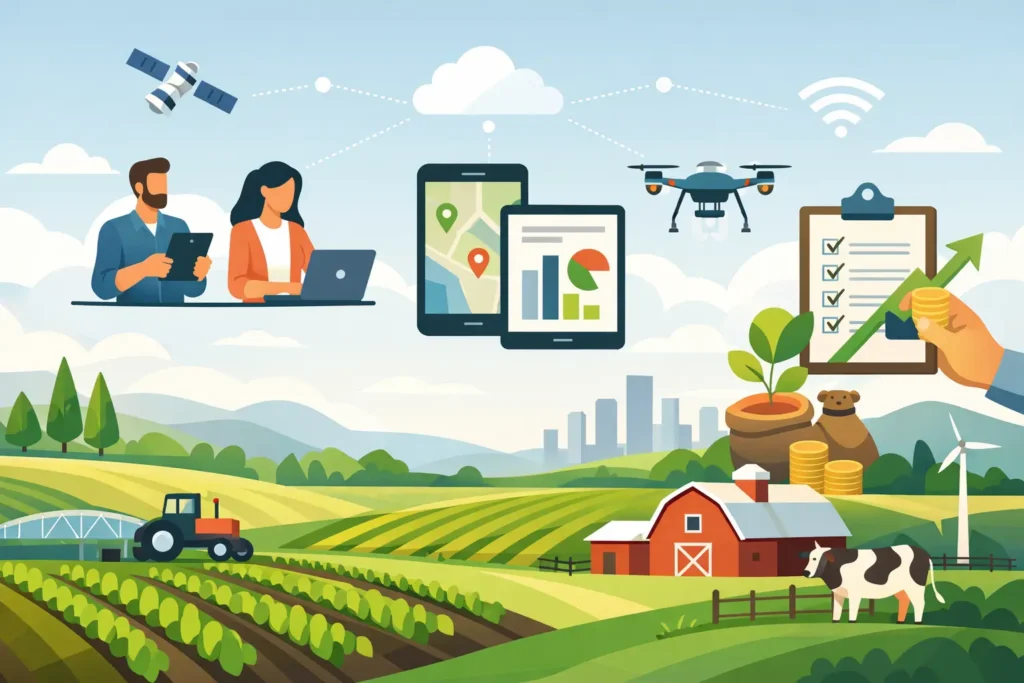
Owning productive farmland from a distance can work very well, but only if the operating structure is built for it from day one. The best absentee farm management models are not just about hiring someone local and hoping for updates. They are about protecting yield, controlling labor, keeping financial visibility, and making sure the farm performs like a business asset rather than a passive land holding.
For investors looking at export-oriented agriculture, especially in crops with demanding production cycles, the management model matters as much as the land itself. A good farm can underperform under weak oversight. A well-structured farm with clear systems, by contrast, can support absentee ownership with far less operational friction and far better decision-making.
What makes an absentee model actually work
Absentee ownership succeeds when three things are in place at the same time. First, someone on the ground must own daily execution. Second, the owner must receive consistent operational and financial reporting. Third, agronomic decisions must be made by people who understand the crop, not just the payroll.
That sounds simple, but many farms fail on one of those points. Some have labor but no real supervision. Some have a caretaker but no production discipline. Others have accounting records that arrive late, without enough detail to evaluate cost per hectare, harvest timing, or contractor efficiency. The best absentee farm management models reduce those blind spots.
1. Owner plus local farm supervisor
This is the most common entry-level model and, in the right setting, it can work. The owner remains the decision-maker on budgets, planting schedules, major repairs, and sales strategy, while a local farm supervisor handles labor coordination, field checks, inputs, and daily issue management.
The strength of this model is cost control. It is lighter than a full management company and gives the owner direct visibility into the farm. It also works well when the property already has an established crop plan and repeatable production system.
The weakness is key-person risk. If the supervisor is strong, the model performs. If that person leaves or loses discipline, output can slip quickly. This structure also depends on the owner being engaged enough to review reports, ask hard questions, and make timely decisions.
2. Owner plus supervisor plus agricultural accountant
For serious buyers, this is often one of the best absentee farm management models because it separates field execution from financial oversight. The supervisor runs the operation, while an agricultural accountant tracks spending, payroll, contractor payments, crop costs, and margin performance.
That separation matters. On many farms, owners lose money not because production fails, but because no one is measuring the operation accurately. An accountant who understands agricultural cycles can show whether labor is drifting, whether fertilizer costs are rising faster than expected, and whether expansion is financially justified.
This model is especially effective for buyers who want a hands-off operating role but still expect disciplined cost controls. It creates stronger reporting without forcing the owner into day-to-day management.
3. Contractor-based labor under local supervision
Permanent labor is not always the most efficient labor structure, especially on farms with seasonal intensity or staged planting schedules. Under this model, a local supervisor directs the work, but much of the labor is delivered through contractors for land prep, planting, maintenance, harvest support, or infrastructure tasks.
Commercially, this can be very attractive. It keeps fixed payroll lean and lets the farm scale labor up or down based on crop stage and acreage in production. For a farm expanding from 20 hectares to 35 hectares of planted output, for example, contractor flexibility can make growth more practical.
The trade-off is quality control. Contractor labor can lower overhead, but only if supervision is firm and standards are clear. In export-grade production, inconsistent field work can become expensive fast. This model performs best when local oversight is experienced and crop-specific.
4. Full-service farm management company
A full-service management company handles the farm as a delegated operator. The company may oversee staffing, agronomy, procurement, reporting, maintenance, harvest coordination, and sometimes market relationships. For owners who want near-total distance from operations, this is the cleanest structure.
It is also the most expensive. Management fees can cut into returns, and performance quality varies widely between providers. Some firms are excellent at administration but weak in field execution. Others are strong agronomically but offer poor owner reporting.
This model makes sense when the owner values simplicity over margin optimization, or when the property is large enough to absorb management fees without weakening overall investment performance. It can also work well for buyers entering a region or crop they do not yet know well.
5. Technical agronomist plus operations lead
For specialized crops, this is often the smartest model even if it is not the cheapest. The operations lead handles people, logistics, supplies, and scheduling. A technical agronomist guides crop health, planting density, nutrition programs, disease prevention, and yield strategy.
This split is valuable because crop expertise and personnel management are different jobs. A good field manager may not be the best technical advisor. A strong agronomist may not be the best person to run crews. Separating the roles can produce stronger output, especially in export-driven agriculture where quality consistency affects revenue.
For pineapple production, where timing, fruit quality, and production discipline matter, this model gives absentee owners a better chance of maintaining commercial-grade standards. The owner does not need to become the technical expert because that function is already built into the operation.
6. Joint venture with local operating partner
Some absentee owners prefer to align with a local operator who has direct economic upside. In this model, the investor owns the land or a majority interest, while the local partner manages operations and shares in profits or performance incentives.
The appeal is alignment. A good local partner has reason to improve yields, contain costs, and protect the asset. This can be one of the best absentee farm management models when trust is high and the agreement is very clear.
It can also become messy. If reporting standards are weak, or if profit-sharing terms are vague, disputes follow. This structure only works when responsibilities, budget authority, reporting cadence, and exit terms are documented in detail. It is not a casual handshake model for serious capital.
7. Turnkey farm with embedded management structure
This is the model many investors should prioritize because it solves the hardest part upfront. Instead of buying raw land and building a system later, the buyer acquires a productive farm with local supervision, accounting oversight, labor structure, and technical knowledge already in place.
That shortens the path to revenue and reduces setup risk. It also makes underwriting easier because the investor can evaluate actual production, current planting, labor methods, expansion capacity, and operating discipline rather than relying on projections alone.
For buyers interested in tropical agriculture, this structure is often the most bankable form of absentee ownership. A business like Buymyfarm.Co is positioned around that exact logic – not just land, but an operating framework designed to support ownership without requiring the buyer to relocate or build a management team from scratch.
Which model is best for most investors?
There is no universal answer, but there is a practical one. If the goal is to balance control, visibility, and profitability, the strongest setup is usually a hybrid model with local supervision, contractor-based labor efficiency, agricultural accounting, and technical crop expertise.
Why? Because it spreads responsibility without creating unnecessary overhead. The supervisor keeps the farm moving. Contractors keep labor flexible. Accounting protects margins. Technical expertise protects yield and quality. The owner stays above the operation, reviewing performance rather than chasing daily problems.
That structure is particularly strong for export-oriented farms where quality and timing drive revenue. It also gives room for expansion. A farm operating efficiently at current planted acreage is in a much better position to scale than a farm that still depends on the owner to solve routine management problems.
What buyers should ask before choosing a model
Before buying any absentee-friendly farm, ask who supervises daily operations, how labor is structured, who tracks costs, how often financial reports are produced, and who makes technical crop decisions. Ask what happens if the local manager leaves. Ask whether the current system can support more planted hectares without a full rebuild.
These questions sound operational, but they are really investment questions. The management model drives labor efficiency, crop consistency, reporting quality, and owner stress. It also shapes the difference between owning land and owning a performing agricultural business.
A productive farm is a real asset. A productive farm with the right absentee management structure is a much stronger one. The right model does not just make ownership easier – it makes the income story more credible, the expansion case more realistic, and the investment far more durable over time.