
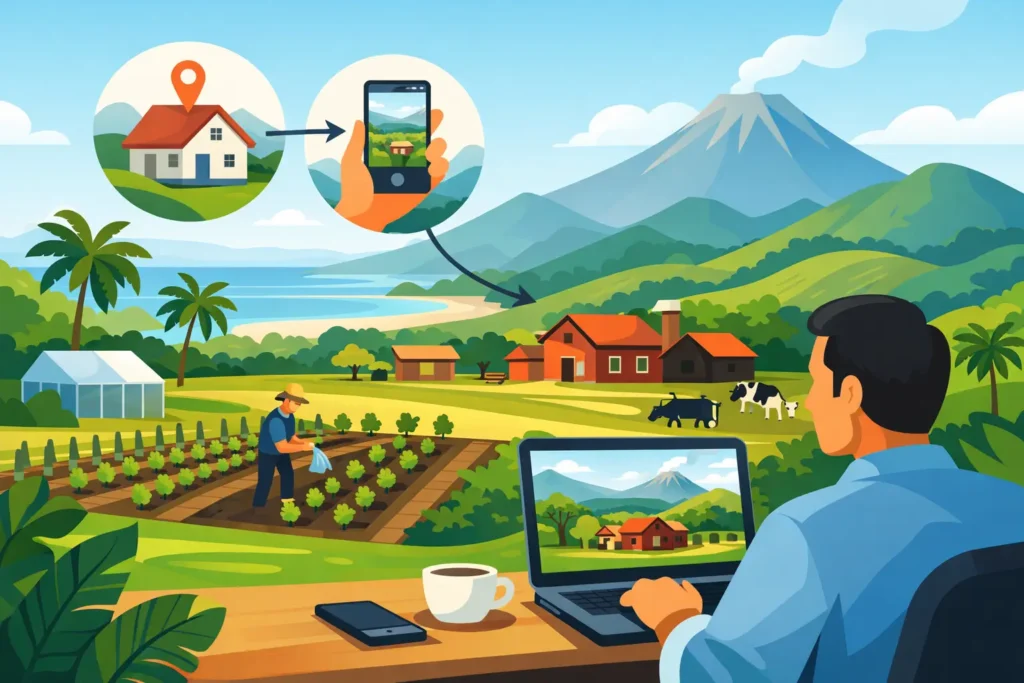
Owning productive farmland in Costa Rica sounds attractive right up until the practical question shows up: who is actually running the farm on Tuesday morning when you are in Texas, Florida, or California? That is the real issue behind operating a farm in Costa Rica as an absent owner, and it is also where most farm purchases either become a business or become a burden.
For the right buyer, absentee ownership is not a compromise. It is the model. But it only works when the farm has the right operating structure already in place – local supervision, reliable contractors, technical crop management, disciplined accounting, and a crop with a clear commercial outlet. Without that structure, distance adds cost, delays decisions, and turns routine field problems into expensive surprises.
What operating a farm in Costa Rica as an absent owner really means
Absent ownership does not mean passive ownership. It means you are not physically on the property every day, but the business still needs active controls. A serious farm investment should run on systems, not on guesswork or heroic effort from the owner.
That matters even more in commercial agriculture. Pineapple production, for example, is timing-sensitive, labor-dependent, and quality-driven. Planting windows, weed control, fertilization, field maintenance, drainage, harvest coordination, and export standards all affect margins. If the owner is absent and the farm depends on informal oversight, performance usually slips.
A better model is simple: local execution with owner visibility. You do not need to live on the farm. You do need to know who is responsible for operations, how costs are tracked, when decisions are escalated, and what output is being produced per planted hectare.
The farm must be built for absentee ownership
Not every rural property is a real absentee-owner farm. Many listings are just land with potential. Potential is expensive if you have to build the whole operating system from scratch.
A farm suited to absent ownership should already have several things working together. First, it needs road access that supports movement of inputs, labor, equipment, and harvested product. Second, it needs a crop model with proven commercial demand. Third, it needs people on the ground who understand production and can execute consistently without daily owner intervention.
This is why established agricultural businesses command more interest than raw land. A fertile 67-hectare farm with active pineapple production on nearly 20 hectares is a different proposition from undeveloped acreage. Add direct access to a main road, export-oriented production standards, and room to scale planting toward 35 hectares, and the investment case becomes clearer. You are not just buying a property line on a map. You are buying operating momentum.
Management is the difference between income and uncertainty
The strongest absentee model usually includes local supervision rather than owner-managed labor. That distinction matters. If every worker reports directly to a foreign owner who is hours away by plane and operating through text messages, small problems grow fast.
A local supervisor creates accountability at field level. Work gets checked, schedules are enforced, and issues are identified before they hit yield or crop quality. In a pineapple operation, that can mean the difference between disciplined production and uneven fields that underperform.
There is a trade-off here. Hiring permanent full-scale staff for every function may feel more controlled, but it often raises fixed overhead. Using contractor-based labor can improve efficiency when the work is seasonal or tied to specific stages of production. The key is not whether labor is direct or contracted. The key is whether labor is managed, measured, and aligned with output.
For an absent owner, contractor-based efficiency often makes more business sense, especially when local supervision and technical agronomy support are already in place.
Accounting has to be operational, not just administrative
Many buyers underestimate this part. They focus on land, crop, and gross revenue, then treat accounting as a back-office task. On an absentee-owned farm, accounting is part of management.
You need timely visibility into input costs, labor expenses, field-level spending, harvest revenue, and margin trends. If agricultural accounting is weak, the owner is essentially flying blind. That is how farms look profitable on paper while cash flow tells a different story.
Operational accounting gives an absent owner confidence. You can review what has been spent, what has been planted, what is expected from harvest, and how performance compares over time. That does not eliminate agricultural risk, but it puts risk in a measurable frame.
For investor-minded buyers, this is where a turnkey farm stands apart from a lifestyle purchase. A commercially managed farm should provide enough structure for you to evaluate it as an operating asset, not just admire it as land ownership.
Why pineapple can fit an absent-owner model
Not every crop is equally suitable for absentee ownership. Some require highly hands-on marketing, fragmented sales channels, or constant owner presence to move product. Export-grade pineapple can be more attractive because it is tied to a known commercial market and a production system that experienced local teams already understand.
That does not make it easy. Pineapple is still intensive agriculture. It requires technical crop expertise and careful execution. But when the farm is already producing and the management framework is established, the owner benefits from a more defined commercial path.
There is also a scale advantage. A property with active production and additional plantable capacity offers room to improve revenue without starting over. Expanding from roughly 20 productive hectares toward 35 hectares is not the same as building a farm business from zero. Expansion inside an existing operating model is usually lower-friction than development from bare land, provided the soils, infrastructure, labor access, and management systems are already supporting the crop.
What buyers should check before they buy
If you are evaluating operating a farm in Costa Rica as an absent owner, the smartest question is not whether absentee ownership is possible. It is whether this specific farm was designed to support it.
Look closely at who handles day-to-day supervision and how often reporting happens. Ask how labor is organized and whether contractors are used to keep costs efficient. Review whether the farm has technical crop expertise attached to the operation, not just available somewhere in the market. Confirm the road access, active production footprint, and realistic expansion capacity.
Then look at numbers with the right mindset. Revenue matters, but revenue without control is fragile. Cost discipline matters just as much. A farm with established oversight, clear field operations, and accountable financial tracking is generally more valuable than one with optimistic yield projections and no management depth.
This is where a platform like Buymyfarm.Co can stand out when it presents farmland as a business asset rather than just a land listing. Serious buyers are not only purchasing acreage. They are purchasing structure, output, and a model that can function while the owner remains abroad.
The real risk is not distance
Distance sounds like the main risk, but usually it is not. The bigger risk is buying an operation that still depends on owner improvisation. If the farm needs you to be there constantly, it is not an absentee-owner investment. It is a relocation project.
For many US buyers, that is not the goal. The goal is to hold a tangible agricultural asset in a stable food-related sector, diversify geographically, and participate in farm income without becoming the field manager. That is a reasonable goal if the operation is mature enough to support it.
A well-run Costa Rica farm can give you land ownership, agricultural upside, and a clear operating framework. A poorly structured one can give you the opposite – recurring decisions, weak oversight, and costs that rise faster than output.
The best absentee-owner farms remove friction. They have the land, the crop, the access, the supervision, the accounting, and the technical support already aligned around production. That is what turns foreign farm ownership from an appealing idea into a disciplined investment.
If you are considering this market, do not ask whether you can own from a distance. Ask whether the farm can perform from a distance. That answer tells you far more about the opportunity than the scenery ever will.