
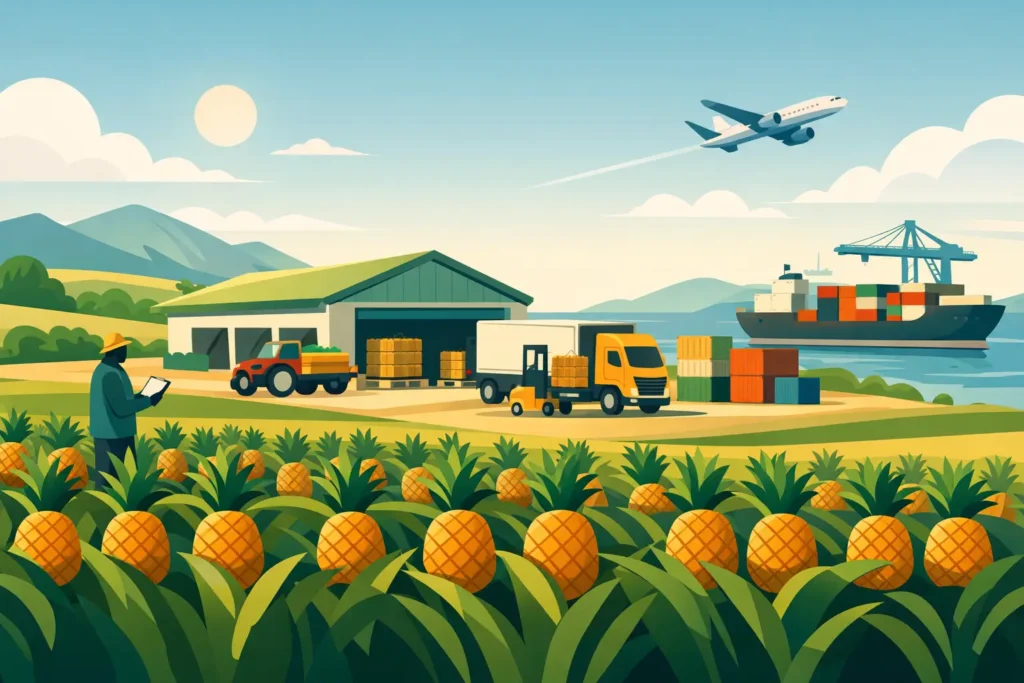
If you want a real pineapple export farm example, start with the numbers that matter to a serious buyer: productive acreage, export-ready crop quality, operating structure, and room to scale without rebuilding the business from zero. That is the difference between buying tropical land and buying an agricultural asset.
For investors looking at Costa Rica, pineapple stands out because the market is already global, the crop is commercially proven, and export standards create a pricing advantage for farms that are organized correctly. A farm built for export is not just a field with fruit. It is a system – land, labor, supervision, accounting, technical crop management, harvest timing, and access that keeps product moving efficiently.
A strong example is a 67-hectare fertile farm with almost 20 hectares already in active pineapple production and the capacity to scale planting up to 35 hectares. That matters because it gives a buyer two assets at once: current output and future upside. You are not paying only for potential. You are acquiring a working operation with measurable expansion capacity.
What makes a pineapple export farm example worth attention
Not every pineapple farm is an export farm. The distinction matters because export-grade production requires consistency. Fruit quality, field management, timing, and logistics all have to line up. A farm can grow pineapple and still fall short as a commercial export business if it lacks supervision, planning, or access.
In this pineapple export farm example, the structure is what makes the opportunity compelling. The property combines fertile land with direct road access to the main road, an active planting footprint, and an operating model built around export-grade agricultural output. That setup reduces the friction a buyer usually faces after acquisition.
For many US-based buyers, the biggest risk is not the crop. It is operational disruption. Buying bare land means hiring a team, building systems, creating financial controls, and learning local execution from scratch. Buying an established farm business is a different decision. You are stepping into an operation with local supervision, agricultural accounting oversight, contractor-based labor efficiency, and technical expertise already in place.
The commercial logic behind the acreage
The 67-hectare size is significant because it offers flexibility. Almost 20 hectares are currently active in pineapple production, which means the farm is not an idea on paper. It is already functioning. At the same time, scalable planting capacity up to 35 hectares creates a clear runway for growth.
That growth capacity is where disciplined buyers tend to focus. A farm with no room to expand can still produce income, but its upside is capped early. A farm with expansion potential can improve revenue without requiring a second acquisition. If roads, management, and crop systems are already working, increasing planted hectares can be more efficient than launching a new farm elsewhere.
Of course, scale is not automatic profit. More planted area increases labor needs, input costs, and execution pressure. But when expansion happens inside an existing operating structure, the economics can be more attractive. The management layer is already there. The land base is already assembled. Access is already in place. That lowers the complexity of growth.
Why road access matters more than many buyers expect
Direct road access to the main road sounds simple, but it affects operations in practical ways. It supports easier movement of labor, inputs, equipment, and harvested fruit. In export agriculture, delays are expensive. Transport inefficiencies can affect fruit condition, labor scheduling, and the overall reliability of the supply chain.
For an absentee owner or international buyer, this point is easy to underestimate. Road access is not just convenience. It is part of operational control. Better access generally supports better timing, easier oversight, and more predictable execution.
Management turns farmland into a business
A productive farm investment becomes far more attractive when the operating model is already organized. That is especially true for buyers who want agricultural exposure without becoming full-time farm managers.
This example is appealing because it goes beyond land ownership. The farm includes an established management structure with local supervision, accounting oversight, contractor-based labor, and technical crop expertise. Those details are not filler. They are central to the investment case.
Local supervision matters because pineapple production is hands-on. Agricultural accounting matters because many farm buyers lose money through weak financial tracking, not poor land quality. Contractor-based labor can improve efficiency when managed correctly, especially in a crop that involves cyclical fieldwork. Technical expertise matters because export-grade output depends on standards, not guesswork.
There is a trade-off here. A turnkey structure reduces startup risk, but buyers should also understand the quality of the team, reporting, and field discipline they are inheriting. The right operating model can save years of setup. The wrong one can hide inefficiencies. That is why commercially minded buyers focus on both output and management quality.
Why pineapple export economics attract investors
Pineapple has a straightforward advantage as an agribusiness play: it is a globally traded fruit with established demand and a commercial production model that experienced operators understand well. That gives investors a more visible path to revenue than many niche crops.
The appeal is stronger when the farm is already producing and already aligned with export standards. In that case, a buyer is not speculating on whether the crop can work in theory. The business has already moved beyond that stage.
For buyers comparing farmland to other alternative assets, this matters. Productive tropical land can offer a mix of hard-asset security and operating income. It is tangible, it serves a basic food-market function, and it can appreciate while also generating revenue through crop production. That combination is difficult to ignore when markets feel overvalued elsewhere.
Still, this is not passive in the same way as owning a bond or a stabilized apartment building. Agriculture has weather risk, biological risk, price variation, and operational dependence. The advantage of an established export farm is not that it removes those realities. It is that it manages them with existing systems rather than asking the buyer to invent solutions after closing.
A practical pineapple export farm example for absentee ownership
Many buyers in the US are not planning to live on the farm full time. They want ownership, income, and exposure to the food sector, but they do not want to supervise field crews every morning. That is exactly where a structured operation has value.
A farm with active production, local supervision, and accounting oversight fits the needs of absentee ownership far better than raw land or a loosely run agricultural property. It gives the buyer a platform. You can monitor performance, review production decisions, and evaluate expansion from a business standpoint rather than from a standing start.
This is where Buymyfarm.Co has positioned the opportunity well. The proposition is not just fertile land in Costa Rica. It is a turnkey pineapple farm investment with demonstrated production, operational controls, and room to grow. For the right buyer, that shortens the path between acquisition and performance.
Who this kind of farm fits best
This type of asset is well suited to buyers who want a real operating business tied to land ownership. It can make sense for agricultural investors seeking geographic diversification, entrepreneurs looking for a managed income-producing asset, and buyers who value food-sector exposure over purely financial products.
It is less suitable for someone looking for a hobby farm or a low-attention lifestyle property with no commercial pressure. Export farming is a business. The reason it attracts serious buyers is the same reason it requires discipline.
The real opportunity in this example
The strongest part of this pineapple export farm example is not any single feature by itself. It is the combination. Fertile 67-hectare land. Almost 20 hectares already producing. Expansion potential up to 35 hectares. Direct road access. Export-oriented operating design. Existing supervision and financial oversight.
Each piece supports the others. Acreage without management is just acreage. Production without access creates friction. Expansion potential without systems can become a cost trap. But when these elements are aligned, the farm starts to look less like a speculative purchase and more like a business with a land-backed foundation.
That is the lens serious buyers should use. Do not ask only whether the farm can grow pineapple. Ask whether the operation can produce, manage, ship, scale, and report like a business worth owning. When the answer is yes, the farm stops being just a property and starts looking like a disciplined way to put capital into tangible, income-oriented agriculture.
The best farm investments usually do not need inflated promises. They need clear acreage, clear operations, and a credible path to stronger output. That is what makes a buyer lean forward.