
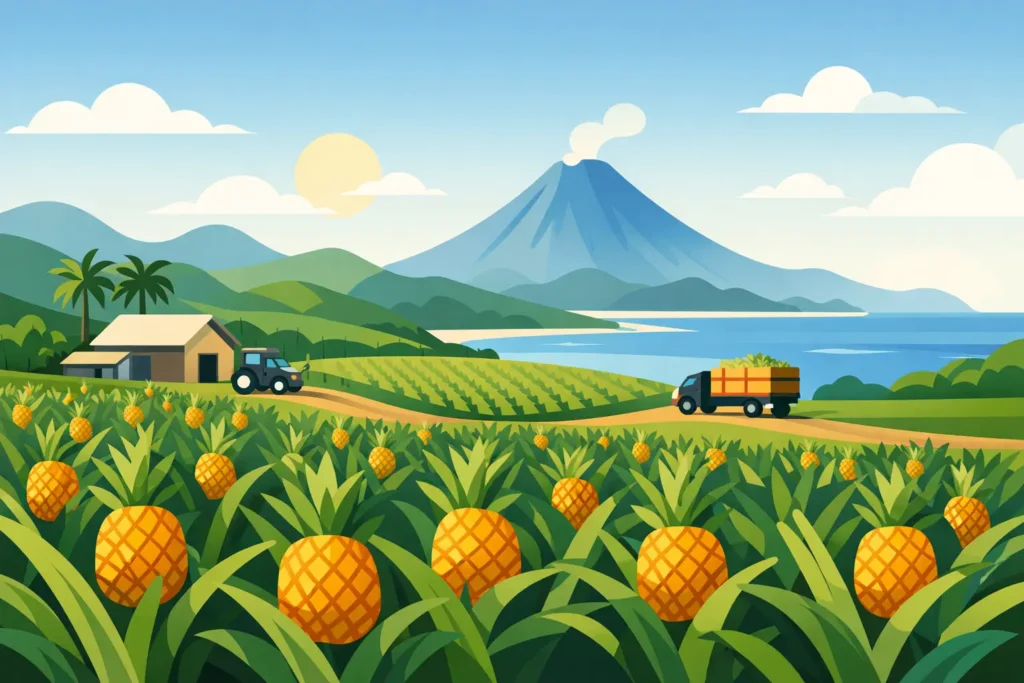
A serious buyer looking at a pineapple farm Costa Rica opportunity is not shopping for scenery alone. The real question is whether the land already works, whether production is proven, and whether the operation can scale without turning ownership into a full-time job. That is where the difference lies between raw farmland and a functioning agribusiness.
Costa Rica continues to attract agricultural investors for one simple reason: productive land tied to export markets can offer a mix of asset security and operating income. Pineapple stands out because demand is international, the crop is commercially established, and well-run farms can move beyond speculative land appreciation into measurable annual output. For buyers who want a tangible asset with revenue potential, this is a category worth looking at closely.
Why a pineapple farm in Costa Rica gets investor attention
Not every farm asset is built the same. Some are essentially undeveloped land plays. Others have production, but weak access, inconsistent supervision, or no real operating discipline. A pineapple farm in Costa Rica becomes more interesting when it combines fertile acreage, road access, export-oriented production, and a structure that supports absentee or semi-absentee ownership.
That matters because many US buyers are not moving onto the farm to manage labor, input purchases, harvest timing, and crop planning themselves. They want an income-producing asset, not a second career. A strong pineapple operation answers that concern by putting management systems around the land. When supervision, agricultural accounting, contractor-based labor, and technical crop expertise are already in place, the buyer steps into an operating business rather than starting from zero.
There is also a practical point about crop choice. Pineapple is a globally recognized commercial fruit with established cultivation methods, existing export channels, and known quality standards. That does not remove execution risk, but it does mean the market is easier to underwrite than a niche crop with uncertain demand.
What separates a real pineapple farm Costa Rica asset from a basic listing
Investors should look past attractive photos and ask operational questions early. How many hectares are currently planted? How much additional planting capacity exists? Is access reliable in all seasons? Is there a management system already handling the fieldwork and financial oversight? These details determine whether the farm is just land with potential or a business with momentum.
A strong example is a 67-hectare fertile farm with nearly 20 hectares in active pineapple production and expansion capacity up to 35 hectares. That profile changes the conversation. Instead of buying a blank canvas, the owner acquires current production plus room to increase planted area over time. Expansion matters because it creates a visible path to revenue growth without the uncertainty of sourcing a second property later.
Direct road access is another operational detail that sounds small until harvest logistics begin. On an export-grade crop, movement efficiency affects labor coordination, transport timing, and the practical cost of getting fruit out. Good access lowers friction. It also makes the farm easier to supervise and easier to maintain as a serious business asset.
The numbers matter more than the narrative
Agricultural buyers with investment discipline do not need romance. They need evidence that the farm can produce, that costs are controlled, and that scale can improve returns. This is why the strongest farm offerings are framed through acreage, production footprint, staffing structure, and crop value potential rather than generic lifestyle language.
A turnkey model is especially relevant here. If the farm already includes local supervision, agricultural accounting oversight, contractor-based labor efficiency, and technical crop management, the owner is not forced to build an operating team from scratch. That saves time, reduces early mistakes, and shortens the path from acquisition to stable oversight.
There is a trade-off, of course. A fully operating farm may carry a higher acquisition price than raw land. But many buyers would rather pay for a proven structure than gamble on lower entry cost followed by months of setup risk, hiring mistakes, and delayed planting schedules. In agriculture, cheap entry can become expensive quickly if the farm sits underutilized.
Scale creates the upside
The most compelling part of a well-positioned pineapple asset is often not only what it produces today, but what it can produce next. A farm with active production on almost 20 hectares and scalable planting capacity up to 35 hectares gives a buyer two value layers at once: current operations and expansion potential.
That expansion potential should be viewed commercially, not emotionally. More plantable pineapple area means the owner can potentially increase output using an existing farm base, existing access routes, and an established operational structure. In many cases, that is more efficient than trying to assemble multiple smaller parcels or retrofitting land not already designed around commercial production.
Still, expansion should be approached with discipline. More hectares can increase revenue, but they also require more working capital, stronger crop scheduling, and tighter management of inputs and harvest cycles. The right move depends on the buyer. Some will prefer immediate optimization of the current footprint. Others will see the additional plantable area as the main reason to acquire the property.
Why hands-off ownership matters
For many internationally minded buyers, the appeal of Costa Rican farmland is not just ownership. It is ownership without daily operational burden. That is why operating structure is as important as soil quality.
An absentee owner needs local execution they can trust. Contractor-based labor can help keep staffing flexible. Agricultural accounting oversight supports visibility into costs and margins. Technical crop expertise reduces the risk of poor agronomic decisions. Local supervision creates continuity on the ground. Put together, those elements turn a farm into a more workable investment for someone based in the US.
This is also where Buymyfarm.Co fits naturally in the market. The value is not merely presenting acreage for sale. The stronger proposition is offering productive farmland with an established management framework and a clear commercial case behind it.
Risk is real, but so is the advantage of a functioning model
No serious investor should treat agriculture as passive in the same way as a bond or a stabilized urban rental property. Crop performance, weather patterns, labor execution, and market conditions all influence outcomes. Pineapple is commercially proven, but it is still farming.
The better question is whether the asset is structured to manage those realities. A functioning farm with active production, technical support, supervision, and room to scale is generally in a stronger position than undeveloped land purchased on optimism alone. Buyers are not removing risk. They are choosing a more controlled version of it.
That distinction matters. There is a big difference between taking agricultural risk with systems already in place and taking startup risk while also learning a foreign market, building field operations, and trying to reach export quality from scratch.
Who this kind of farm is actually for
This is not a fit for every buyer. If someone wants a hobby property or a retreat with no commercial pressure, a pineapple business may feel too operational. But for a buyer who values hard assets, income potential, food-sector exposure, and geographic diversification, the profile is attractive.
It especially suits entrepreneurs and investors who want a business asset tied to land rather than a purely financial instrument. The appeal is straightforward: productive acreage, existing pineapple operations, expansion potential, and a hands-off management structure that supports disciplined ownership. That mix is hard to find in one property.
For US buyers evaluating alternative investments, a Costa Rican pineapple farm can also serve as a hedge against the abstract nature of many modern portfolios. Land is tangible. Crop production is measurable. Operations can be reviewed through real acreage, real output, and real cost controls.
A good farm purchase should feel exciting, but it should also stand up to commercial scrutiny. If a property offers fertile land, current pineapple production, direct road access, scalable planting capacity, and a management model built for export-grade output, it deserves a serious look. The smartest buyers are not chasing novelty. They are buying productive ground that already knows how to work.