
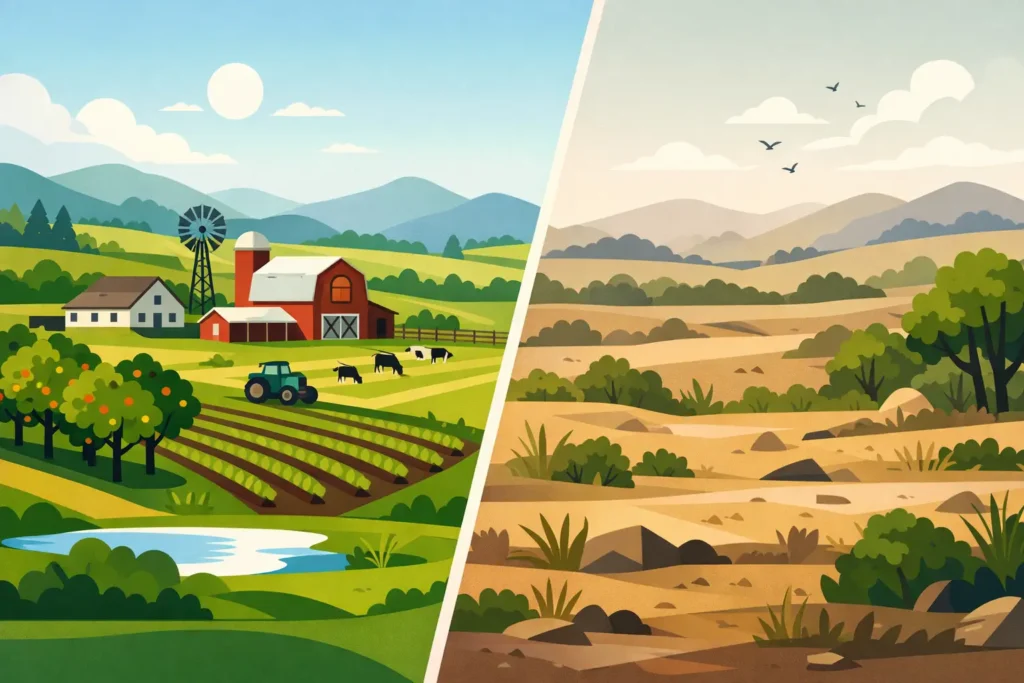
A buyer looking at tropical farmland usually hits the same fork in the road fast: managed farm versus raw land. On paper, raw land can look cheaper. In practice, the cheaper entry price often hides the most expensive part of the deal – turning idle acreage into a functioning agricultural business.
For an investor, entrepreneur, or absentee owner, this decision is less about romance and more about time, execution, and return. The question is not simply what land costs today. It is what the asset can produce, how quickly it can produce it, and how much risk sits between purchase and revenue.
Managed farm versus raw land: what are you really buying?
Raw land is a blank operating platform. You are buying soil, location, water access, road access, and future possibility. That can be attractive if your strategy is long-term appreciation or if you have the local team, technical expertise, and patience to build from zero.
A managed farm is a business asset wrapped inside the land purchase. You are not only buying hectares. You are buying production history, operating systems, local supervision, crop knowledge, labor coordination, and a defined path from ownership to commercial output. If the farm is already producing, the asset begins with a much clearer economic identity.
That distinction matters because farmland is not valuable only because it exists. It becomes more valuable when it is organized to generate reliable agricultural income. In export-oriented crops, that organization is often the difference between a promising property and a profitable one.
The real cost gap is wider than the listing price
Raw land often wins the first glance because the purchase price can be lower. But serious buyers know acquisition cost is only one line item. Once you buy undeveloped or unmanaged agricultural land, you still need to solve infrastructure, crop planning, labor, supervision, equipment access, accounting control, and commercial timing.
If your goal is pineapple or another export-grade crop, the setup phase gets even more technical. You need planting design, soil preparation, field execution, contractor management, disease control, harvest scheduling, and quality discipline. That takes capital, but more importantly, it takes competent local management.
A managed farm can carry a higher entry price because much of that work has already been done. The premium is not just for convenience. It is often payment for reduced startup friction, shorter time to cash flow, and lower execution risk. Buyers who focus only on land price can miss the fact that raw land may require a second investment cycle before it behaves like a business.
Cash flow changes the investment profile
The sharpest difference in managed farm versus raw land is cash flow. Raw land is usually a waiting game. It may appreciate. It may become productive later. It may fit a future development plan. But until operations are built, it is generally a carrying asset, not an earning asset.
A managed farm offers a very different profile. If acreage is already under active production, buyers can evaluate current output, planted area, expansion capacity, cost structure, and management systems. That makes underwriting far more disciplined. You are no longer buying only upside. You are buying present performance with future scale.
For many US-based buyers looking at Costa Rica, this is the practical hinge. They are not moving on-site to build an agricultural operation from scratch. They want a tangible asset with food-sector relevance and a pathway to revenue without becoming full-time farm operators. In that context, a managed farm usually aligns better with the actual purchase objective.
Absentee ownership favors operating structure
A lot of international farm purchases fail at the ownership model, not the land quality. The buyer lives abroad, trusts the property, but has no reliable structure on the ground. That creates slow decision-making, weak oversight, labor inefficiency, and poor cost visibility.
Raw land gives you maximum flexibility, but it also gives you maximum operational burden. You need to assemble the farm management architecture yourself. That means finding local supervisors, building contractor relationships, tracking expenses correctly, and making sure the crop program is executed on schedule.
A managed farm lowers that burden substantially when the structure is already in place. Local supervision, agricultural accounting oversight, contractor-based labor, and technical crop expertise are not side benefits. They are core value drivers, especially for buyers who want ownership without daily field management. This is where turnkey farm investments separate themselves from simple land listings.
Development risk is real, and it is rarely priced honestly
Many buyers underestimate development risk because undeveloped land looks simple. Clear the fields, plant the crop, hire some people, and get moving. That is the theory. The reality is usually slower and more expensive.
Agriculture runs on timing. Miss the right preparation window, delay planting, mismanage labor, or underbuild field systems, and your first production cycle can lose both momentum and margin. Even strong land can underperform when the operating model is weak.
A managed farm reduces some of that uncertainty because you can review what is already functioning. Is there active production? Is there direct road access? Is labor organized efficiently? Is crop expertise already embedded in the operation? Is there room to scale beyond current planted hectares? These are the details that turn a farm from speculation into a more measurable investment.
That does not mean every managed farm is automatically superior. A poorly run farm can still be a poor purchase. But compared with raw land, a producing operation gives buyers more evidence and fewer assumptions.
Managed farm versus raw land in Costa Rica
Costa Rica attracts buyers for obvious reasons – fertile ground, global food relevance, export potential, and a stable investment story tied to real assets. But for foreign buyers, local execution matters as much as the land itself.
In this market, road access, field readiness, crop suitability, and local operating know-how are not minor factors. They directly affect cost, harvest logistics, labor reliability, and commercial consistency. A productive farm with management in place can remove years of trial and error.
That is why investment-grade agricultural properties stand apart from vacant acreage. A 67-hectare farm with active pineapple production, direct road access, export-minded operating standards, and scalable planting capacity is not being valued like passive dirt. It is being valued like a working agribusiness with room to expand. For the right buyer, that difference is the opportunity.
When raw land still makes sense
Raw land is not the wrong choice in every case. It can make sense if you have a long investment horizon, strong local execution partners, and a clear strategy for phased development. It can also work for buyers who want complete freedom over crop selection, land use design, or future resale positioning.
There is also a pricing argument. If you can acquire exceptional land at the right number and you are equipped to build professionally, the upside can be substantial. But that upside belongs to buyers who are prepared for the work, the delays, and the capital demands that follow closing.
For buyers who mainly want asset control and optionality, raw land may fit. For buyers who want agricultural income, operating visibility, and a shorter path to commercial return, managed farms usually carry the stronger logic.
The better question is not cheaper or better
The better question is which asset matches your real investment model. If you want to create an agricultural business from the ground up, raw land offers control. If you want to own a producing farm with systems already operating, a managed farm offers speed and structure.
That is why managed farm versus raw land should be evaluated through three filters: time to revenue, operational complexity, and execution risk. Once those are on the table, the decision becomes clearer. A lower entry price is not automatically a better deal if it delays cash flow and increases management exposure.
For many serious buyers, the most valuable part of a farm purchase is not just the hectares. It is the fact that the land is already behaving like a business. That is where a property moves from aspiration to asset, and from ownership to opportunity.
If you are buying farmland as an investment, treat the management system with the same seriousness as the soil. Good land matters. A working operation is what turns it into a real business.