
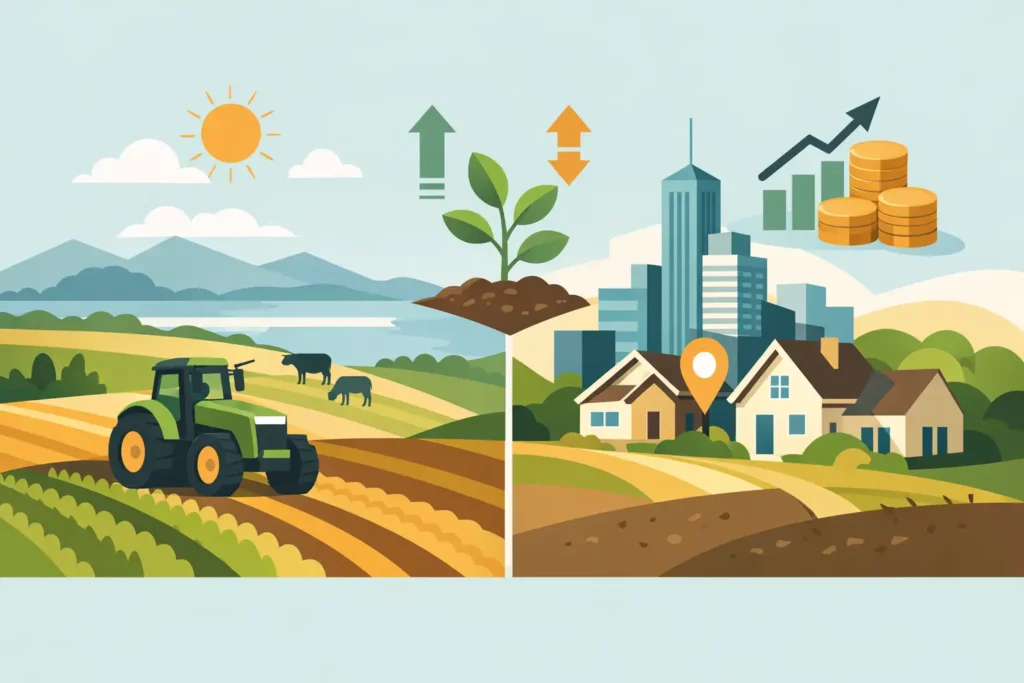
A farm can look inexpensive per acre and still be costly to own. Another property may command a higher price yet deliver stronger cash flow, lower operating risk, and a clearer path to expansion. That is the core question behind what affects agricultural land value: buyers are not simply pricing dirt. They are pricing production capacity, market access, water security, operating control, and the ability to turn acreage into dependable income.
For US investors considering productive farmland in Costa Rica, this distinction matters. A tropical farm with proven export crops, direct road access, and local management can be a very different asset than raw land with attractive views but no operating foundation.
What affects agricultural land value beyond acreage?
Acreage sets the starting point, not the finish line. Two 67-hectare farms can have sharply different values if one has fertile, usable ground, active crop production, reliable water, and infrastructure while the other requires years of clearing, planting, permitting, and trial-and-error management.
Productive agricultural land is valued on both its physical qualities and its earning potential. The strongest properties bring those two elements together: the land can support a valuable crop, and the business is organized to produce, harvest, and sell that crop efficiently.
For a serious buyer, the right question is not, “What is the price per hectare?” It is, “What income can this hectare produce, what does it cost to operate, and how reliably can that performance continue or improve?”
Soil quality and usable planting area
Soil is one of the most durable drivers of farm value. Fertile ground with suitable drainage, structure, and nutrient capacity can support higher yields and reduce the amount of correction required before planting. In tropical production, the difference between land that is naturally suited to a crop and land that needs extensive remediation can materially affect both startup costs and annual margins.
But buyers should look beyond a broad description such as “fertile farm.” Ask how much of the acreage is actually plantable, how much is already in production, and what limits exist across the remaining land. Steep terrain, seasonal saturation, poor drainage, protected areas, or inefficient field shapes can reduce usable capacity even when total acreage appears substantial.
A property with 20 hectares of active pineapple production and room to scale planting to 35 hectares has a clearer value case than an equally sized property where productive acreage has not been established. Existing production provides evidence. Expansion capacity adds upside, provided water, labor, capital, and market demand can support it.
Crop fit matters as much as soil quality
Good soil has value only when it fits a marketable crop. Pineapple, coffee, bananas, cattle, vegetables, and timber each require different conditions, production cycles, and logistics. A farm located in a proven pineapple-growing area may benefit from local crop knowledge, available contractors, established input channels, and a workforce familiar with the production process.
That local ecosystem reduces execution risk. It does not eliminate it. Disease pressure, weather volatility, input costs, and export standards still need to be managed. Yet a buyer generally pays more for land that has already demonstrated its agricultural fit than for land with only theoretical potential.
Water security and climate resilience
Water can determine whether a farm is an operating business or a seasonal speculation. Reliable rainfall may support production in some regions, but investors should still evaluate water sources, irrigation capacity, drainage systems, seasonal patterns, and the legal right to use available water.
Too little water can limit yields. Too much water without adequate drainage can damage roots, delay fieldwork, and create disease pressure. Climate resilience is therefore not just about having a water source. It is about whether the farm’s soil, topography, drainage, and crop plan can handle changing conditions.
Costa Rica’s tropical environment can offer productive growing conditions, but microclimates vary significantly. Elevation, rainfall, wind exposure, and local weather patterns can affect crop performance within relatively short distances. Buyers should assess farm-specific records rather than relying only on regional averages.
Access, logistics, and proximity to markets
A productive crop has limited value if it cannot move efficiently. Direct road access to a main road can improve farm value because it reduces transport time, lowers vehicle wear, supports dependable labor access, and makes it easier to move inputs in and harvest out.
For export-oriented agriculture, the logistics chain deserves the same attention as the fields. Buyers need to understand travel time to packing facilities, ports, airports where relevant, input suppliers, and service providers. Perishable crops are particularly sensitive to delays, handling quality, and transportation reliability.
Accessible farms also tend to be easier to supervise, insure, finance, maintain, and eventually resell. Remote land may be cheaper at acquisition, but the discount can disappear through higher operating costs and greater management complexity.
Existing income and financial proof
Income-producing farms are typically valued differently from vacant or undeveloped agricultural land. Established operations provide a buyer with a starting point for evaluating revenue, costs, margins, crop cycles, and capital needs. That information supports disciplined underwriting.
Revenue alone is not enough. A high gross sales figure can conceal expensive labor, transport, fertilizer, packing, machinery, or crop losses. Investors should review historical production volumes, sales pricing, operating expenses, contractor costs, management fees, and any recurring repair or replanting requirements.
The most valuable operations show more than a promising top line. They demonstrate cost controls and a repeatable process. A farm with agricultural accounting oversight, documented crop expenses, and regular production reporting is easier to evaluate than one run through informal records and verbal estimates.
Value is tied to the quality of the income
Not all farm income carries the same risk. Contracted buyers, export-grade quality standards, diversified sales channels, and a proven harvest history can strengthen the durability of revenue. By contrast, a farm dependent on one buyer, one season, or an unproven crop strategy may warrant a lower valuation even if its recent results look attractive.
This is where investment logic matters. Buyers should distinguish between current income, normalized income, and projected income. Current income is what the farm is producing now. Normalized income adjusts for unusual events or one-time costs. Projected income reflects future planting, expansion, price assumptions, and operational improvements. Each has value, but they should not be priced as if they carry identical certainty.
Management systems can increase farm value
For an absentee owner or internationally based investor, operations are often the difference between an attractive asset and an unmanageable one. Productive land needs supervision, labor coordination, technical expertise, purchasing discipline, crop scheduling, maintenance, and financial controls.
A turnkey farm structure can therefore add meaningful value. Local supervision provides day-to-day oversight. Contractor-based labor can keep staffing flexible around planting and harvest needs. Agricultural accounting creates visibility into costs and cash flow. Technical crop expertise helps protect quality and yields.
These systems do not replace investor oversight. They reduce the burden of building an operating team from zero. That can shorten the path from acquisition to stable ownership and lower the risk of costly early mistakes.
Buyers should still ask practical questions: Who makes field decisions? How are contractors paid and monitored? What reports are available? Is key knowledge held by one person, or documented across the operation? A farm with processes that can transfer to a new owner is generally more valuable than one dependent on an owner’s personal relationships.
Infrastructure and capital requirements
Roads, drainage, storage, equipment, worker facilities, fencing, irrigation, and utilities all influence agricultural land value. Useful infrastructure can support production immediately. Deferred maintenance can become a hidden acquisition cost.
The right level of infrastructure depends on the farm’s crop model. A pineapple operation may not need the same buildings as a dairy farm, but it does need dependable field access, material handling, crop protection capabilities, and logistics coordination. Buyers should inventory what is included, what condition it is in, and what investments are needed over the next one to three years.
A lower purchase price can be attractive when capital improvements are straightforward and clearly budgeted. It is less attractive when the farm requires unknown repairs before it can generate reliable income.
Expansion potential and highest-use value
Scalability can materially increase value when it is real, not hypothetical. Additional plantable acreage, access to labor, adequate water, and a workable route to market can allow an operator to grow revenue without acquiring another property.
However, expansion is not automatically profitable. Planting more hectares requires capital, working cash, management capacity, and confidence that output can be sold at acceptable margins. Buyers should model expansion conservatively, including the time between planting and revenue, additional input costs, and the possibility that market prices change.
The most compelling opportunities pair existing income with measured room to grow. That structure gives investors a working base while preserving optionality for future production increases.
Location, legal clarity, and resale appeal
Agricultural value is also influenced by factors that do not appear in a crop spreadsheet. Clear title, defined boundaries, legal access, zoning compliance, tax status, and environmental obligations all affect ownership security. International buyers should conduct thorough legal and technical due diligence with qualified local professionals before relying on any farm projection.
Resale appeal matters as well. A property with good access, demonstrated production, clean records, productive soil, and transferable operations will usually appeal to a broader pool of future buyers than isolated raw land. That broader demand can support value when it is time to exit or refinance.
A farm should be purchased as a business asset first and an aspiration second. The aspiration is real: owning fertile tropical land and participating in the food sector can be deeply rewarding. But the strongest purchase decisions come from verifying what the land can produce, how the operation controls costs, and whether the next hectare of growth can generate more than it consumes.