
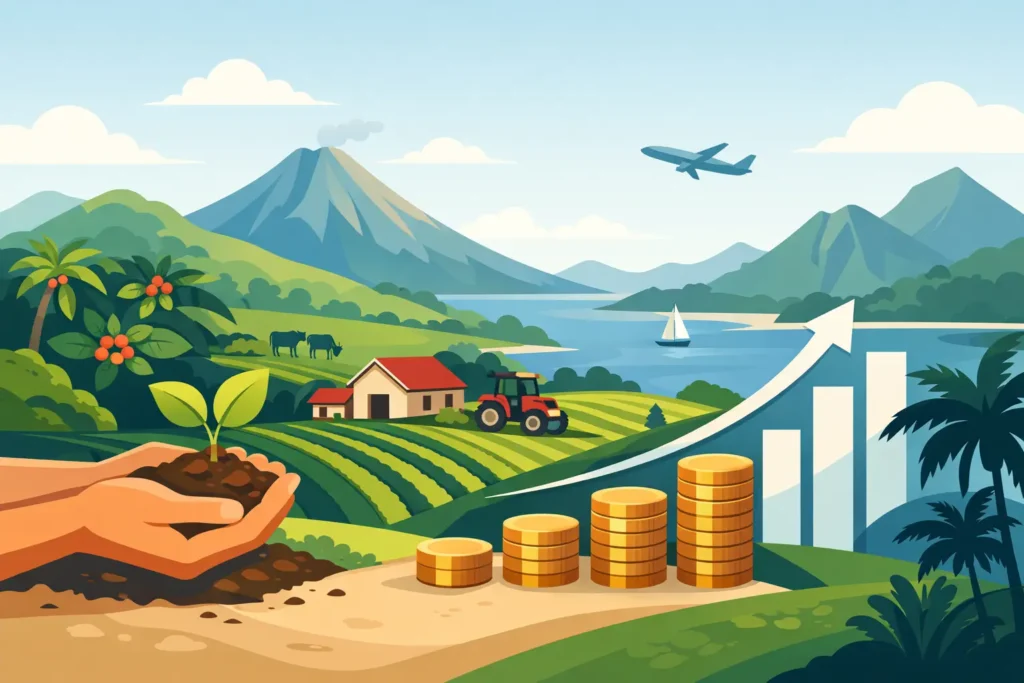
A farm investment should not begin with a postcard view or a promise of cheap acreage. It should begin with productive land, a crop that has a defined market, operating controls, and a realistic path from ownership to income. For buyers seeking a tangible asset outside traditional markets, an established pineapple operation in Costa Rica can offer a more disciplined entry point than purchasing raw land and attempting to build a farm from zero.
The opportunity is straightforward: acquire 67 hectares of fertile agricultural land with nearly 20 hectares already in active pineapple production, then build toward as much as 35 hectares of planted production capacity. Direct access to the main road supports the practical side of the business – moving supplies, labor, fruit, and equipment efficiently. More importantly, the operation is structured for export-grade agricultural output rather than small-scale hobby farming.
What Makes a Farm Investment Investable?
Farmland becomes an investment when the asset has more than acreage behind it. Buyers need to see the relationship between land quality, crop performance, operational costs, sales potential, and the people responsible for execution. A productive farm is not passive in the literal sense. Crops require timing, supervision, technical knowledge, labor coordination, and financial discipline. The goal is not to eliminate management. It is to avoid becoming the unpaid full-time manager from another country.
That distinction matters for U.S. investors evaluating Costa Rica. Buying undeveloped agricultural land may offer a lower entry price, but it also creates a longer and riskier road to revenue. The buyer must organize soil preparation, planting material, irrigation or water strategy where needed, labor, crop protocols, accounting, harvest planning, and commercial relationships. A turnkey operating farm compresses that development period by bringing an existing production model into the acquisition.
For an absentee owner or entrepreneur with other businesses, the strongest structure combines ownership control with capable local execution. That means local supervision on the ground, agricultural accounting oversight, contractor-based labor, and technical crop expertise that can respond to conditions in the field. These are not decorative features in an offering. They are the operating foundation that helps protect crop quality and cost control.
Why Pineapple Production Changes the Equation
Pineapple is a commercial crop with an established role in international produce markets. In the right region, fertile tropical conditions and experienced production practices can support a focused export-oriented operation. That does not make pineapple risk-free. It does make it a crop with a recognizable value chain, measurable production milestones, and a clear reason for farmland to be managed as a business.
A buyer should look beyond general claims about tropical agriculture and ask specific questions. What acreage is actively planted today? What is the condition and age of each planting block? How is crop quality monitored? What are the expected harvest windows? Which costs are fixed, which vary by hectare, and how are labor contractors managed? The answers reveal whether revenue potential is supported by an organized operating system.
Nearly 20 hectares in active production gives an incoming owner an operational base rather than a blank canvas. The ability to expand to 35 hectares creates a second layer of value: growth can be pursued through phased planting rather than a separate land purchase. That flexibility matters because expansion should follow market conditions, capital availability, and the farm’s demonstrated performance. More planted acreage can increase output, but it also increases working-capital needs, labor requirements, and exposure to execution mistakes.
Productive Acreage Is Only Part of the Asset
A 67-hectare farm offers room for more than the crop currently in the ground. The central investment question is how much of that land can be productively and profitably developed over time. In this case, the farm’s scalable planting capacity supports a practical expansion plan without requiring the owner to search for neighboring parcels or redesign logistics from the beginning.
Road access is equally commercial. Farms can lose efficiency when inputs take too long to arrive or harvested fruit faces difficult transport routes. Direct access to a main road strengthens daily operations and supports the movement required by an export-grade crop. It also improves the property’s long-term usefulness because access is a durable land characteristic, not a temporary operating result.
The existing farm structure adds another layer of value. An investor is not simply purchasing dirt, fencing, and future plans. The acquisition includes an established management approach designed around local supervision and cost awareness. Contractor-based labor can give the operation flexibility to match field activity with the crop calendar, rather than carrying an unnecessarily heavy permanent payroll. Agricultural accounting oversight helps translate field activity into financial visibility, allowing an owner to evaluate cost per hectare, planting expenses, harvest costs, and margins with more discipline.
How to Evaluate the Operating Case
The best farm investment decisions are made through verification, not enthusiasm. A productive operation should be examined from both the field and the financial records. Buyers should request a clear breakdown of current planted acreage, historical production, crop sales, operating expenses, labor structure, maintenance costs, and anticipated capital needs. They should also understand the timing mismatch that can occur in agriculture: expenses are often incurred before harvest revenue arrives.
Land and crop due diligence should be equally detailed. Confirm title, boundaries, access rights, water availability and use, soil condition, topography, and any environmental or regulatory considerations relevant to the property. Review the condition of roads, drainage, packing or handling arrangements where applicable, equipment, and farm infrastructure. The right professional team can help buyers evaluate these details before closing, especially when the buyer is acquiring property in another country.
Commercial diligence matters as well. Export-oriented farming depends on quality standards, logistics, buyer requirements, and market pricing. No seller should present agriculture as guaranteed income, because weather, disease pressure, input costs, foreign exchange, and commodity-market movement can all affect results. A stronger investment case acknowledges those variables and shows how professional crop management, efficient labor, road access, and expansion discipline can reduce avoidable risk.
Ownership Without Daily Field Duty
Many investors want the security of land ownership but do not want to relocate or spend every morning managing crews. That is a reasonable objective, provided expectations are clear. Hands-off ownership does not mean no oversight. It means the owner has an operating framework, reliable reporting, and experienced people who handle daily execution.
A well-run model gives the owner visibility into acres planted, crop progress, labor activity, major expenses, harvest expectations, and sales performance. It also creates accountability. When management and accounting are organized locally, the owner can make decisions based on farm data rather than occasional updates or assumptions. This is particularly valuable for internationally minded buyers who see Costa Rican farmland as part of a broader asset portfolio.
Buymyfarm.Co presents this type of acquisition as more than a land purchase: it is an opportunity to own a working agricultural business with active pineapple production, established oversight, and room to expand. For the right buyer, that combination can support both the personal appeal of owning fertile tropical land and the commercial logic of entering the food sector through an operating asset.
The Right Buyer Sees Both Potential and Discipline
This farm is suited to an investor who values tangible assets but understands that productive agriculture requires operational rigor. It may appeal to a buyer seeking geographic diversification, a business owner looking for a real-asset component, or a family that wants ownership connected to food production and long-term land value. It is less suitable for someone expecting immediate, effortless returns or treating tropical farmland as a vacation property with incidental income.
The real opportunity lies in acquiring productive acreage with a working crop, an operating structure, road access, and expansion capacity already in place. A careful buyer can then assess the farm on its actual numbers, its field condition, and its ability to grow at a controlled pace. The next useful step is simple: review the production and cost data closely enough to decide whether this is land you would be proud to own and a business you would be confident to operate.