
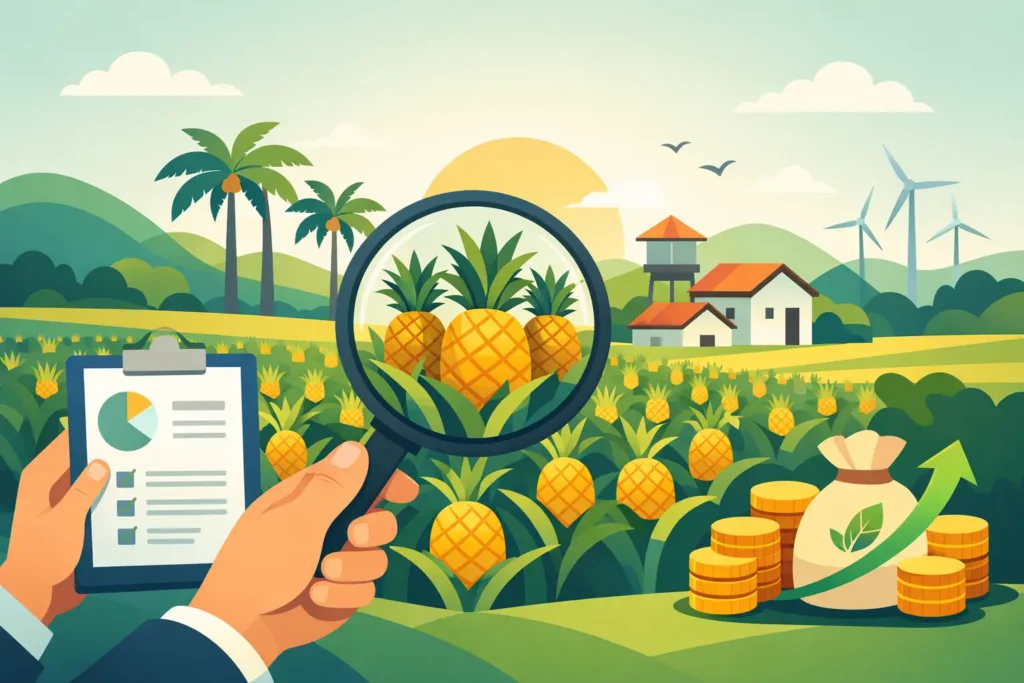
A vacant tropical property and a producing farm are not the same asset. When you are buying a pineapple farm, the real question is not whether the land looks attractive. It is whether the farm is already positioned to generate export-grade output, control operating costs, and scale production without forcing the owner to build the business from zero.
That distinction matters because pineapple is a commercial crop, not a hobby crop. Buyers who approach it like a lifestyle purchase often underestimate what drives returns – road access, planting density, technical oversight, labor structure, harvest timing, and market-ready fruit quality. Buyers who treat it like an operating business usually see the opportunity more clearly. They are not just acquiring hectares. They are acquiring productive capacity.
What buying a pineapple farm should really include
The strongest pineapple farm opportunities combine land, production, and management. Raw land can be cheap for a reason. It may need infrastructure, drainage work, crop planning, labor sourcing, and years of execution before it performs at a commercial level. A producing farm, by contrast, starts with established momentum.
That is why serious buyers tend to look past simple acreage totals and focus on usable production area. A 67-hectare farm with nearly 20 hectares already in active pineapple production tells a very different story than 67 undeveloped hectares with no crop base. If the same property also has the capacity to expand planting to 35 hectares, the upside becomes easier to quantify. You are looking at current output plus room for disciplined growth.
In practical terms, buying a pineapple farm should include four things. It should include fertile land with proven agricultural performance, active crop production, a workable labor and supervision model, and access that supports transport and logistics. Without those elements working together, the investment case gets weaker fast.
The numbers behind a commercial pineapple operation
Pineapple attracts investors because it sits at the intersection of food demand and export economics. But the appeal is not based on the fruit alone. It comes from how efficiently the farm can produce marketable yield.
An investor-grade farm should show more than gross sales potential. It should demonstrate how revenue is produced and protected. That means understanding planted area, crop cycles, expected yield per hectare, input costs, labor efficiency, supervision, and the margin structure after operating expenses. If those figures are vague, buyers are being asked to purchase a promise. If those figures are clear, buyers can evaluate the farm like any other income-producing asset.
This is where an established operating model matters. Contractor-based labor can improve cost control when it is managed properly. Local supervision reduces absentee-owner risk. Agricultural accounting oversight creates visibility instead of guesswork. Technical crop expertise supports fruit quality and timing, both of which directly affect realized value. These are not add-ons. They are part of the business.
A buyer should also consider expansion economics. Adding planted area sounds simple, but profitable expansion depends on whether the farm already has the systems to handle it. If the roads, labor structure, supervision, and agronomic support are already in place, scaling from 20 hectares of production toward 35 hectares is a commercial opportunity. If not, expansion can become expensive and slow.
Buying a pineapple farm in Costa Rica makes strategic sense
Costa Rica stands out for buyers who want productive tropical land tied to the food sector. The climate supports pineapple production, the country has a recognized agricultural export profile, and experienced local farm labor and technical knowledge are available. For US-based investors, that combination offers both diversification and operational relevance.
Still, not every Costa Rican farm is equal. Location inside the country matters. Road access matters even more than many first-time buyers expect. A farm with direct access to the main road has a practical advantage that affects transport time, labor access, supply delivery, and operational friction. Those details do not look dramatic in a listing, but they show up in margins over time.
There is also a strategic ownership angle. Many buyers are looking for an asset that is tangible, income-oriented, and connected to long-term food demand. Productive farmland checks those boxes in a way many paper investments cannot. For internationally minded investors, it can also create geographic diversification without moving into a business they have to personally operate every day.
What makes a turnkey pineapple farm different
A turnkey farm is not just a farm with a crop in the ground. It is a farm where ownership and operations are already aligned.
That means there is an existing management structure instead of a blank page. It means local supervision is already solving daily issues before they become expensive. It means the accounting is organized around agricultural realities. It means technical decisions about planting, maintenance, and harvest are guided by experience instead of trial and error.
For many buyers, especially those based in the US, this is the difference between an investable asset and a full-time job. Absentee ownership is possible when the farm has operational discipline. It is much harder when the buyer is expected to recruit teams, design systems, manage agronomy, and build controls after closing.
A turnkey structure also improves clarity during due diligence. Buyers can assess actual operating methods rather than hypothetical plans. They can review how labor is handled, how supervision is structured, and how the farm supports production quality. That reduces uncertainty, which is valuable in any acquisition.
The trade-offs buyers should weigh
There is no perfect farm, only the right farm for the buyer’s objective. Some investors want maximum current production. Others are willing to buy a property with lower current output if the expansion case is compelling. Some prioritize hands-off management. Others want more direct involvement.
Buying a pineapple farm with active production usually means paying for an established business, not just land value. That can raise the purchase price compared with undeveloped acreage. But it can also reduce startup risk, shorten the path to revenue, and avoid the common cost overruns that come with building operations from scratch.
Another trade-off is between scale and simplicity. A larger property with expansion potential can offer stronger upside, but it also requires confidence that the management model can support growth. A smaller operation may feel easier to understand, yet it may cap future returns. The right answer depends on whether the buyer is prioritizing stability, upside, or a balance of both.
There is also the practical question of crop specialization. A pineapple farm is a focused agricultural investment. That concentration can be attractive when the farm is well run and market aligned, but buyers should still think in terms of operating resilience, not just crop appeal. Quality control, cost structure, and execution matter more than romantic ideas about tropical ownership.
How serious buyers should evaluate the opportunity
The best buyers approach the purchase like an acquisition, not a vacation fantasy. They ask how much land is truly productive today, how much can be brought into production, what the operating model looks like, and whether the farm is already built for export-grade output. They want evidence of revenue logic and cost control.
They also look closely at who is doing the work. If local supervision is in place, if contractor labor is organized efficiently, and if crop expertise is already embedded in the operation, that has real value. It means the owner is stepping into a functioning business framework rather than trying to assemble one in an unfamiliar market.
This is exactly why a property offered through Buymyfarm.Co can appeal to entrepreneurial buyers who want more than land. The right farm combines fertile acreage, current pineapple production, direct road access, and a management structure designed to support commercial returns. That is a stronger proposition than buying dirt and hoping operations come together later.
Why the best pineapple farm deals are about timing
Food-sector assets tend to attract attention when investors want something tangible, productive, and defensible. A producing pineapple farm can fit that demand well because it combines land ownership with ongoing agricultural income and future planting capacity. When the farm already has nearly 20 hectares in production and room to scale to 35 hectares, the opportunity is not theoretical. It is visible.
That said, timing matters on both sides. Buyers benefit when they move before a scalable farm is fully built out and repriced to reflect expanded production. Sellers benefit when they can show a clear path from current operations to future output. The gap between those two points is often where the strongest investment case sits.
For a buyer with capital, patience, and a business mindset, the appeal is straightforward. You are not just purchasing tropical land. You are acquiring a productive platform in a globally relevant food category, with acreage, operations, and expansion potential already aligned around commercial performance.
The best closing thought here is simple: if you are considering buying a pineapple farm, do not ask whether the property is beautiful first. Ask whether the business is already working.