
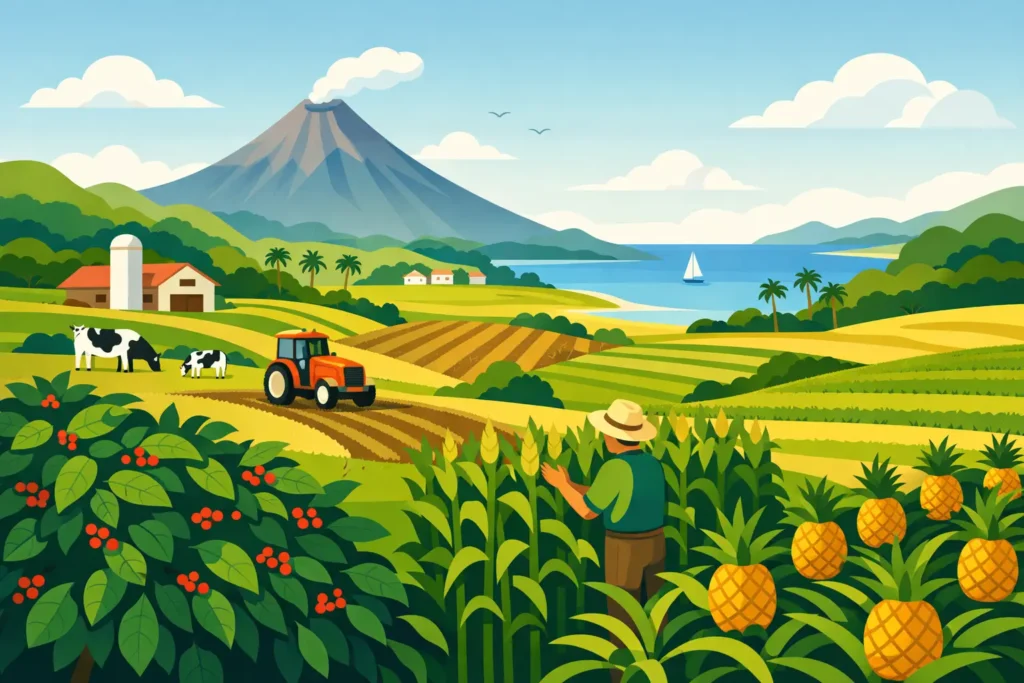
A farm can look exceptional from the road and still be a weak business purchase. The real value of Costa Rica agricultural land is not defined by green scenery or low cost per acre. It is defined by what the soil can produce, how efficiently the crop can reach market, and whether the operation can perform without requiring the owner to live on-site full time.
For buyers seeking a tangible asset with operating income, Costa Rican farmland offers a serious opportunity. Tropical growing conditions, export infrastructure, and established agricultural expertise make it possible to own productive land tied to the global food supply. But productive acreage and profitable acreage are not automatically the same thing. The difference comes down to crop selection, water, access, labor structure, management, and the room to scale.
What Makes Costa Rica Agricultural Land Investable
A farm investment starts with the land, but it should not end there. Fertile soil and a favorable climate are valuable only when they support a crop with market demand and a workable cost structure. Pineapple is one example of a crop that can turn tropical acreage into an export-oriented business when it is managed to commercial standards.
Costa Rica has long-standing experience in tropical agriculture. Its climate supports year-round production cycles in suitable regions, while road networks and export channels can connect farms with international buyers. For a US investor, this creates a practical case for geographic diversification: an asset backed by real land, food production, and a crop that has an established place in export markets.
Still, location is not a substitute for due diligence. Rainfall patterns differ by region. Soil drainage, topography, water availability, and road conditions can change dramatically from one property to the next. The right farm is not simply land in Costa Rica. It is land with the physical and operational characteristics to support a defined agricultural business.
Productive Acreage Beats Headline Acreage
Large acreage is appealing, but buyers should focus on usable, plantable, and commercially accessible hectares. A 100-hectare farm with poor internal access, difficult terrain, or limited water can be less useful than a smaller farm with level ground, healthy soil, dependable roads, and crop-ready infrastructure.
This is especially relevant for buyers evaluating pineapple production. Planting capacity must be separated from current production. A farm may have active crop hectares generating revenue now, plus additional suitable land that can be developed as capital and market conditions justify expansion. That structure gives an investor both immediate operating potential and a clear route to future growth.
For example, a 67-hectare farm with almost 20 hectares in active pineapple production is not being valued only for its total footprint. Its investment case includes the existing crop, the agricultural systems already in motion, and the potential to expand planting toward 35 hectares. That distinction matters. The buyer is acquiring both a current business and the capacity to build a larger one.
Road Access Is a Revenue Issue, Not a Convenience
Direct road access is often treated as a lifestyle feature. On a commercial farm, it is a revenue and cost-control issue. Harvested fruit must move quickly and reliably. Inputs, contractors, equipment, and supervisors must be able to reach the property without delays that drain labor hours or disrupt fieldwork.
A farm connected directly to a main road has a more efficient foundation than one dependent on long, poorly maintained access routes. Better access can reduce transportation friction, simplify oversight, and improve the practical ability to move export-grade product into the supply chain.
Buyers should inspect the road during different weather conditions where possible. A route that works in the dry season may become a problem during heavy rains. Ask how trucks enter the farm, where harvested product is staged, and how travel time affects the harvest schedule. These are operating questions, not minor details.
The Farm Must Work When You Are Not There
Many buyers are attracted to Costa Rica because they want an income-producing farm without relocating permanently. That can be achievable, but absentee ownership only works when local execution is already built into the business.
A raw land purchase leaves the investor responsible for assembling every moving part: farm supervision, crop planning, labor, agricultural accounting, contractor relationships, technical advice, procurement, and sales coordination. Building that structure from outside the country takes time and creates avoidable risk.
An operating farm with local supervision and agricultural accounting oversight is a different proposition. It gives the owner visibility into production and cost performance while placing day-to-day field decisions with people who understand the local growing environment. Contractor-based labor can also make a farm more efficient when used correctly, allowing labor to flex around planting, maintenance, and harvest requirements rather than carrying unnecessary fixed payroll.
That does not mean a buyer should be passive. Good ownership requires reporting, financial review, crop planning, and clear decision rights. It does mean the farm can operate as a business asset instead of becoming a full-time overseas job.
How to Evaluate Pineapple Economics
Pineapple is not a set-it-and-forget-it crop. Export-grade production depends on disciplined field management, correct planting material, fertilization, pest and disease control, harvest timing, quality sorting, and dependable market coordination. A farm’s crop value should be measured by saleable fruit, not by theoretical yield.
Before buying, ask for a clear view of the operating model. Review planted hectares by age, historical harvest volumes, quality standards, sales channels, input costs, contractor costs, transportation, and management expenses. If financial records are available, look beyond gross revenue. The key question is what remains after the farm has paid to grow, harvest, manage, and move the crop.
Seasonality also matters. Cash flow can be uneven because agricultural costs occur before harvest revenue arrives. Buyers should understand the working capital required to maintain the crop cycle and fund expansion. A farm with demonstrated revenue and controlled costs is more compelling than a cheaper property that will need years of capital before it produces meaningful output.
Expansion Should Be Planned, Not Assumed
Additional plantable land is valuable, but expansion is not automatically profitable. More hectares require more planting material, field preparation, labor, inputs, technical oversight, and working capital. They may also require stronger logistics and a reliable outlet for additional volume.
The best expansion plan is phased. Start with a farm that has productive acreage today, then increase planted area when crop performance, capital availability, and market demand support the move. This approach gives the owner a chance to verify the management model before committing to full-scale development.
For a farm with capacity to increase pineapple production from almost 20 hectares to as much as 35 hectares, the opportunity is measurable. The buyer can evaluate the cost of bringing each additional hectare into production, the expected timing of harvest, and the operational resources needed to protect quality at a larger scale. Growth becomes an investment decision with numbers behind it, not a vague promise.
Questions Serious Buyers Should Ask
The strongest farm purchases come from specific answers, not optimistic assumptions. A buyer should confirm legal title and boundary information, understand water sources and any applicable rights, inspect soil and drainage conditions, and review access routes. Just as important, they should assess the farm’s operating records and the people responsible for execution.
Ask who supervises the property each week, how labor is contracted and paid, who tracks agricultural expenses, and how crop decisions are made. Request clarity on active production, future planting capacity, current infrastructure, and the timeline required to bring new hectares into commercial output.
It is also wise to use independent legal, accounting, and agricultural professionals during the acquisition process. A turnkey operation reduces the burden of starting from zero, but it should still be verified with the same discipline applied to any income-producing investment.
Own Land With a Business Behind It
The most attractive Costa Rica farm opportunities combine ownership appeal with operational proof. You are not buying a concept of future agriculture. You are acquiring fertile land, active production, a management framework, and a path to expand when the numbers support it.
For the right buyer, that combination can offer more than a place to own in the tropics. It can create a disciplined position in food production, supported by a real asset that can be inspected, measured, improved, and managed for long-term value. The strongest next step is to look past the view and ask the question that matters most: what is this farm producing now, and what can it reliably produce next?