
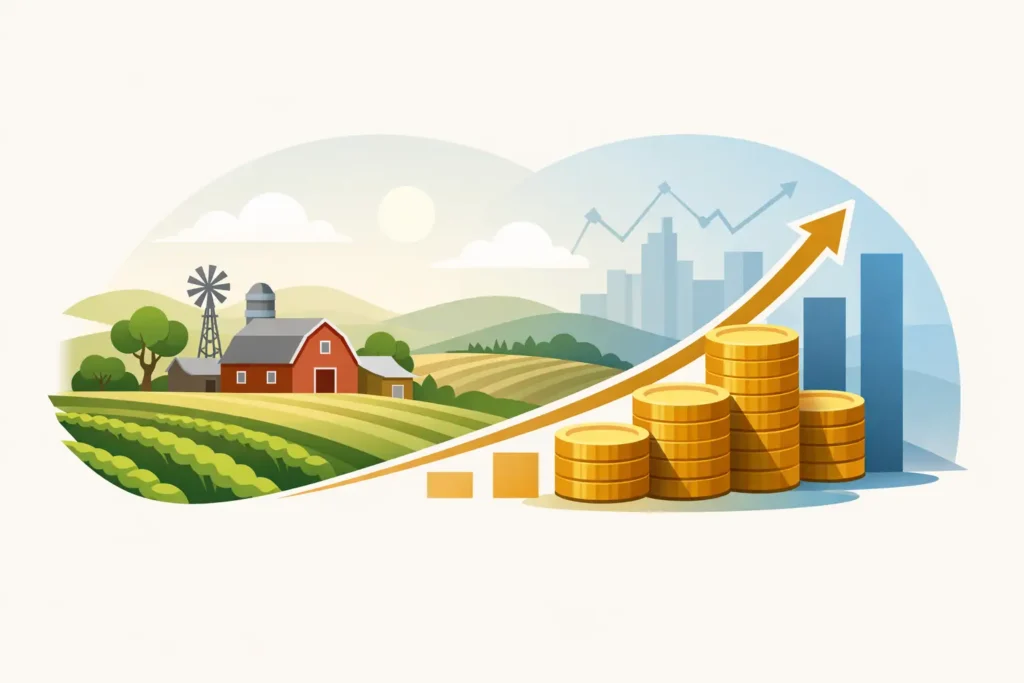
When inflation starts cutting into cash, bonds feel thin, and public markets swing on headlines, serious investors usually ask a simple question: is farmland a hedge? The short answer is yes – but only when the land is productive, the operation is disciplined, and the revenue model is tied to real agricultural output rather than idle acreage.
That distinction matters. Not all farmland behaves the same. A passive parcel with no infrastructure, no crop plan, and no operational oversight is very different from a working farm producing export-grade crops with revenue already in motion. For buyers looking at agricultural real estate as a capital preservation play, that gap is where the real investment case sits.
Is farmland a hedge in real-world investing?
Farmland has long attracted capital for one reason that is easy to understand: people keep eating. Food demand does not disappear because interest rates rise or stock multiples contract. That gives productive agricultural land a basic economic footing that many financial assets do not have.
But the stronger reason farmland can function as a hedge is that it combines two forms of value. First, there is the underlying land itself, which is a finite hard asset. Second, there is the operating income generated from crops, leases, or vertically managed production. When both are present, investors are not relying on appreciation alone. They own an asset that can potentially rise in value while also producing cash flow.
That combination is especially relevant during inflationary periods. Input costs may rise, but food prices often rise too. In well-run operations, some of that pricing power can pass through to revenue. If the farm is producing a crop with strong export demand, established market channels, and attractive margins, the hedge becomes more than theoretical.
Why productive farmland tends to hold value
The best inflation hedges usually share a few traits. They are tangible, scarce, and tied to essential demand. Farmland checks all three boxes.
Land is tangible in the most literal sense. It is not a paper promise. It cannot be printed, diluted, or reissued. Scarcity is also real. High-quality agricultural land with water access, road access, suitable climate, and commercial-scale production potential is limited. Once strong farm regions are built out or absorbed into other uses, supply does not expand easily.
Then there is demand. Productive land serves the food chain, and that gives it a practical use case beyond speculation. This is where investors often separate farmland from other real assets. A warehouse needs tenants. An office building needs occupiers in a changing work environment. Farmland needs a viable crop, capable management, and access to buyers. If those elements are in place, the asset is tied to something essential rather than discretionary.
That does not mean values move in a straight line. Weather events, commodity cycles, labor costs, and export markets all affect returns. But over time, productive land often shows resilience because its utility does not disappear when investor sentiment turns negative.
What makes farmland a stronger hedge than raw land
A common mistake is to treat all rural property as equivalent. It is not. Raw land may offer long-term upside, but a working farm offers a different and often stronger investment profile.
The difference comes down to execution. A productive farm has systems, crop planning, labor structure, management oversight, and a revenue engine. That gives buyers a path to immediate or near-term operational performance rather than a purely speculative hold. In inflationary conditions, time matters. An asset already generating agricultural output is usually in a better position than one that still needs permits, clearing, planting strategy, infrastructure, and management hiring.
For example, a tropical farm with fertile acreage, existing pineapple production, direct road access, and room to scale planted hectares offers more than land ownership. It offers an operating business attached to the land. That matters to investors who want capital protection but also want a credible path to earnings.
This is one reason turnkey agricultural operations stand out. If the farm already has local supervision, contractor-based labor efficiency, accounting oversight, and technical crop expertise, the hedge is not resting on land value alone. It is supported by operating discipline.
Is farmland a hedge against inflation or just a long-term hold?
The honest answer is that it can be both.
As an inflation hedge, farmland can help because land values and agricultural revenues may rise alongside broader price levels. As a long-term hold, it also benefits from scarcity, population growth, and ongoing food demand. The strongest opportunities often sit at the intersection of those two ideas.
Still, investors should avoid oversimplifying the case. Farmland is not a perfect hedge in every year or every region. If crop prices weaken while fertilizer, fuel, and labor costs rise, margins can tighten. If a farm lacks infrastructure or management, inflation may increase costs faster than revenue. And if an investor overpays for land based on optimism alone, the hedge can disappoint.
This is why quality matters more than category. The right farm in the right production model can be a strong hedge. The wrong farm can become an expensive project.
The income side is what strengthens the thesis
A lot of investors like the idea of farmland because it feels safe. That instinct is understandable, but safety in agriculture comes from more than ownership. It comes from output, margins, and operating structure.
Income-producing farmland has an advantage over non-income-producing real assets because it does not depend entirely on resale. If the farm generates revenue from active crop production, there is a business case supporting the land value. That changes the investment conversation.
For US buyers considering international agricultural assets, this can be particularly attractive when the farm is structured for export-grade production. A crop like pineapple can offer commercial scale, repeatable harvest economics, and access to global food demand. If the operation is already functioning and has room for expansion, the investor is buying into a platform, not just a parcel.
That is a much stronger position than waiting years for a raw asset to become productive.
Where the risks are real
A serious investor should want the trade-offs, not just the upside.
Farmland carries operating risk. Weather can hit yield. Disease pressure can reduce crop performance. Labor availability can tighten. Input prices can move fast. Export logistics can shift. Local regulations, water access, and management quality all matter. These are not small details. They shape whether farmland behaves like a reliable business asset or a management headache.
There is also liquidity risk. Farmland is not a push-button asset class. Selling can take time, especially if the property is highly specialized or poorly documented. Cross-border buyers should pay close attention to title clarity, operating records, cost controls, and on-the-ground accountability.
This is why absentee-friendly management structures matter so much. Investors who do not want to build a farm team from scratch should value existing supervision, technical knowledge, and clear agricultural accounting. Those pieces reduce friction and improve visibility.
What investors should look for if they want farmland as a hedge
If the goal is protection with upside, buyers should focus less on acreage alone and more on operational quality. Fertile land is essential, but it is only the starting point.
Look for a farm with proven production, commercially relevant crop selection, accessible infrastructure, and realistic scaling potential. Review whether the operation has established labor systems, local management, and cost tracking. Confirm that the crop fits the region and that the region supports transport and market access.
It also helps when the farm has a clear business model. A property designed around export agriculture, efficient contractor-based labor, and expansion capacity is easier to analyze than one built on vague potential. Investors are not just buying scenery. They are buying a production asset.
In that sense, the most investable farms are the ones that reduce unknowns. They do not eliminate risk, but they replace guesswork with operating facts.
The better question is not just is farmland a hedge
The better question is this: what kind of farmland, under what management model, and with what revenue profile?
That is where smarter buyers separate themselves from casual land shoppers. A high-quality farm can protect capital, generate income, and benefit from long-term food demand. A weak farm can absorb capital and ask for more.
For investors who want a tangible asset with practical utility, geographic diversification, and business-level upside, productive farmland deserves serious attention. And for those evaluating tropical agriculture, a turnkey operation with current production and room to scale may offer one of the clearest versions of that thesis.
Buymyfarm.co is built around that idea – not just land for sale, but a working agricultural asset with a management structure and commercial logic already in place.
If you are asking whether farmland belongs in a defensive portfolio, the answer may be less about theory and more about execution. The right farm is not just a hedge. It is a business with land underneath it.